
Vacuum Drainage for Below-Grade Construction and Complex Renovations
When a building’s lowest floor sits below the public sewer, or when structural, historic, or site constraints make sloped drainage piping impractical, conventional gravity drainage can become costly, difficult, or even impossible to implement. Vacuum drainage offers an alternative. By using negative pressure rather than gravity to move wastewater, it allows piping to run horizontally, overhead, or upward, giving architects and engineers far more flexibility in below-grade construction and complex renovations. For plumbing and wastewater drainage systems, the traditional method is gravity drainage. Vacuum plumbing and vacuum wastewater drainage systems are newer but can offer greater flexibility and numerous benefits when addressing common construction challenges.
Gravity drainage depends on pipes maintaining a continuous downward slope at a specified grade. This requirement can become a significant challenge below grade, where existing foundations, utilities, structural elements, bedrock or variations in site elevation may limit the available space for properly sloped piping. Vacuum systems can help overcome these constraints by reducing reliance on gravity and providing greater flexibility in routing underground drainage piping.
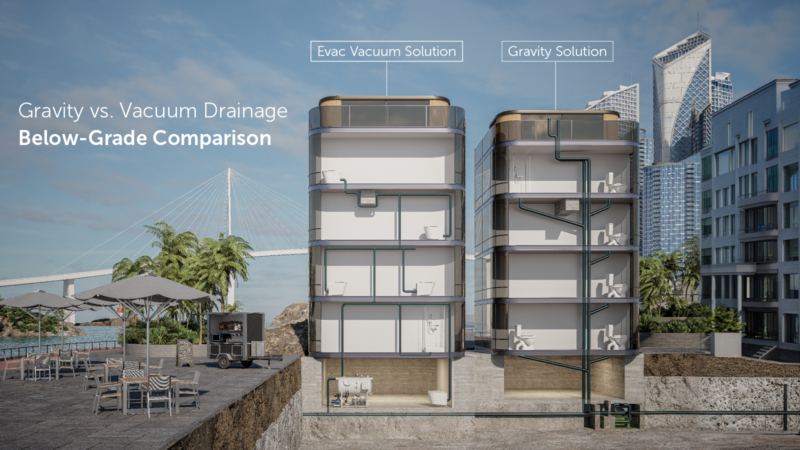
Gravity Drainage vs. Vacuum Drainage
Gravity Drainage Systems – Traditional gravity drainage systems use gravity to move wastewater and waste down pipes to a municipal sewer main or a lower-level sewage collection point.
Vacuum Drainage Systems – A vacuum drainage system uses negative pressure to move waste and wastewater through a closed network of pipes. Unlike a gravity-based system, it can move waste against gravity and around obstacles, including up slopes or even vertically.
The key difference below grade is where piping can go. Gravity drainage pipes must fall continuously toward the sewer, which typically means running them beneath the lowest floor slab. Vacuum drainage pipes can run within ceiling voids, walls, or service zones above the floor, so drainage routes are no longer dictated by the slab, the ground beneath it, or the depth of the sewer connection.
For a full overview of how vacuum drainage works, take a look at our guide on What is a Vacuum Drainage System.
Where Underground and Below-Grade Construction Becomes a Consideration
Because of their flexibility, vacuum drainage systems are often desirable when site terrain presents challenges. These include, but are not limited to:
- Bedrock or rock obstructions – Dense rock may require blasting or cutting, which can increase the cost and difficulty of achieving the required pipe alignment.
- Insufficient slope – A lack of a natural downward gradient, typically a ¼-inch-per-foot drop for small pipes, can slow or halt the movement of waste and water.
- Excessive slope – Steep or hilly terrain can cause excessive velocity, resulting in liquids separating from solids and leaving solid waste behind. Large elevation drops can also create high hydrostatic pressure at lower levels, increasing the risk of pipe damage.
- Shifting ground – Areas with shifting clay, erosion or significant freeze-thaw cycles can damage pipes and create low spots where waste and sludge can accumulate. Vacuum piping routed within the building structure is less exposed to ground movement.
- High water table – In areas with high water tables, dewatering, or removing groundwater from excavations, can be a significant challenge. Vacuum drainage systems can reduce or, in some cases, eliminate the need for dewatering and trench stabilization.
Vacuum Plumbing for Remodeling Projects
In remodeling projects, vacuum plumbing systems may help solve problems related to:
- Incorrect invert elevations – Incorrect pipe elevations can disrupt gravity flow and require major redesign, significant demolition and construction, or an alternative solution such as a vacuum drainage system.
- Difficult structural elements – Examples include post-tensioned slab foundations (slab-on-grade foundations reinforced with high-strength steel cables encased in plastic sheathing), central steel columns, primary concrete piers and lateral-resistance shear walls, all of which can require significant cost, effort and time to modify.
- Historic building restrictions – Historic structures often have restrictions on what can be changed. Vacuum plumbing systems can help address these restrictions by offering benefits such as:
- No floor trenching required
- Protection of historic flooring, tiles and structural foundations
- Ability to bypass hazardous materials, such as asbestos
- No gravity slope required
Vacuum Drainage vs Pumped Drainage Below Sewer Level
When fixtures sit below the level of the public sewer, gravity cannot carry wastewater away by itself, and the conventional alternative is a pumped system, such as sewage ejector pumps or packaged pumping stations. In a pumped system, wastewater typically drains by gravity to one or more low-lying containers or pits, where pumps lift it to the sewer.
A vacuum drainage system also lifts wastewater, but it does so from a central unit rather than from distributed containers.
Case Study: Below-Sewer-Level Hotel Conversion: Zedwell, London
Premise: Zedwell Hotels discovered an abandoned underground car park in London’s West End. Consistent with the company’s brand, which focuses on sleep quality, relaxation and well-being, they converted the structure into a 207-bedroom hotel, which opened in 2023.
Challenge: All 207 bedrooms would be completely below the public sewer level. Traditional gravity drainage would not work.
Solution: Evac’s vacuum technology for below-grade development. Gravity drainage would have required significant and expensive pumping infrastructure – if it was possible at all.
- Each guest room was installed with an Evac Optima 5 wall-mounted vacuum toilet and an Evac interface unit.
- Wastewater was drawn through small-diameter vacuum pipes routed within ceiling voids.
- All sewage flowed to central Evac Type 30 HQE 300 vacuum collection units, where it was then piped to the communal sewer at street level.
In addition to elegantly solving a construction and design challenge, the vacuum plumbing system saves more than 2.5 million liters of water annually compared with conventional toilets. To find out more about this feat, read more here.
Case Study: Historic Building Conversion: The Chancery Rosewood, London
Premise: London’s former U.S. Embassy, a landmark building designed by Eero Saarinen, was converted into the Chancery Rosewood Hotel.
Challenge: How to reconfigure the 137 guest rooms with modern bathrooms while maintaining the building’s historic and structural integrity.
Solution: A conventional gravity drainage system would have required hundreds of large-diameter penetrations and significant below-grade excavation. Vacuum technology instead made it possible to route piping horizontally with minimal riser points, similar to electrical conduits and HVAC ducts.
This approach preserved the building’s historic and architectural character while enabling larger room footprints, higher ceilings and multiple bathrooms in each suite without core drilling through protected structural elements. The remodel utilized 192 Evac Optima 5S vacuum toilets and 559 greywater interface units. The units use only 1.2 liters per flush and utilize existing sewer infrastructure.
Read more here.
Case Study: Stadium Renovation: Shanghai Stadium, China
Premise: The Shanghai Stadium sports venue was renovated to transform it from a multi-purpose Olympic-style venue into a football-focused arena, increasing capacity from 58,000 to more than 72,000 seats. The changes to the structure included removing the old running track to bring spectators closer to the field, extending the steel roof structure and adding facilities such as media spaces and VIP hospitality zones.
Challenge: Using a gravity drainage system was deemed unworkable due to the structural changes required during the renovation.
Solution: More than 1,000 Evac vacuum toilets and 1,000 Evac interface units were engineered across nine vacuum stations. The renovation resulted in water savings of more than 80% compared with traditional systems, saving millions of liters of water annually.
Vacuum Drainage Systems Can Minimize Complications with Underground and Below-Grade Construction
Vacuum drainage systems aren’t the right solution for every construction or remodeling project. However, factors such as complex terrain, high water tables or complicated or historically protected structures can make conventional gravity-based drainage difficult and costly.
In projects where traditional plumbing and drainage would require extensive excavation or structural modifications, vacuum-based systems offer significant design and installation flexibility, as well as potential sustainability and economic benefits.
To learn more about Evac’s line of total vacuum solutions, contact us today!
Contact Evac Built Environment team
Planning a new build, renovation or conversion? Tell us a little about your project, and our Built Environment team will show you how vacuum plumbing can help you meet your design, space and sustainability goals.