
What Is a Vacuum Drainage System?
Understanding the Technology and Applications
A vacuum drainage system is a method of collecting and transporting wastewater that uses negative air pressure, rather than gravity, to move waste through a building. Instead of relying on large-diameter pipes laid at a continuous downward slope, the system maintains a network of smaller, airtight pipes under constant vacuum. The principle has long been used on aircraft and cruise ships, where space and water are limited, and it is now applied in commercial buildings, healthcare facilities, and renovation projects.
Whether planning a new commercial building or renovating an existing facility, flexibility, sustainability, and cost-effectiveness are top priorities. Choosing between a vacuum drainage system and a conventional gravity system can significantly affect all three.
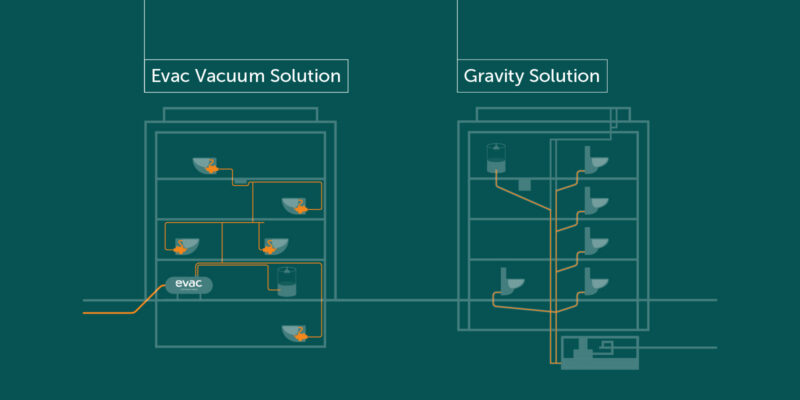
Traditional Plumbing Systems Versus Vacuum Plumbing Systems
One of the most important considerations when designing a new building or renovating an existing one is the drainage system.
In most settings, traditional gravity-based plumbing is the most common approach to wastewater removal. This method depends on gravity to remove sewage and wastewater from appliances, including toilets, sinks, baths, and showers. Although gravity systems have been used successfully for centuries, they require careful engineering. In renovation projects especially, maintaining the continuous downward slope needed for proper drainage can present significant design challenges.
A vacuum drainage system requires four things:
- An appliance
- Airtight piping
- A collection unit
- A generation unit to create the vacuum
Vacuum drainage technology utilizes negative pressure to move liquids and solids through a closed network of pipes. Unlike a traditional gravity-based system, it can move waste against gravity, including up slopes or even vertically.
Advantages of a Vacuum Drainage System
In situations where design constraints, sustainability goals, or renovation challenges are priorities, vacuum drainage systems offer several advantages over conventional gravity systems.
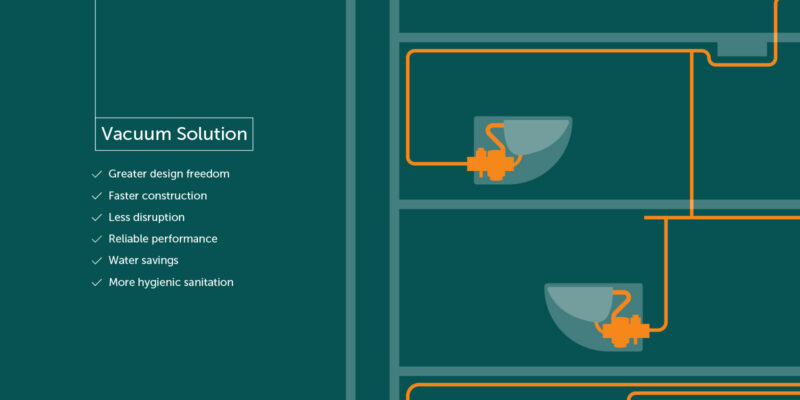
Greater Design Flexibility
- Smaller-diameter piping reduces space requirements.
- Wastewater can be transported horizontally, vertically, or overhead without maintaining a continuous downward slope.
- Eliminates the need to penetrate concrete slabs in many installations.
- No lift pump stations with multiple underground collection sites are required.
Reliable Performance
- Blockages and sedimentation are virtually nonexistent due to high water velocity in the vacuum system.
- In the event of a pipe leak, air enters the system rather than wastewater escaping.
- No vent stacks are necessary for appliances and interfaces.
Simplified Renovations
- Faster installation can reduce project timelines.
- Due to smaller-diameter pipes that can run in different dimensions, reworking existing drainage systems is simplified, which saves labor, time, and materials, which can offset higher equipment costs.
- Reduced labor, material, and drilling requirements can help offset the higher initial equipment investment.
- Vacuum systems can help maximize space utilization and convert otherwise non-usable space into valuable space.
Sustainability with Water Savings and Hygiene
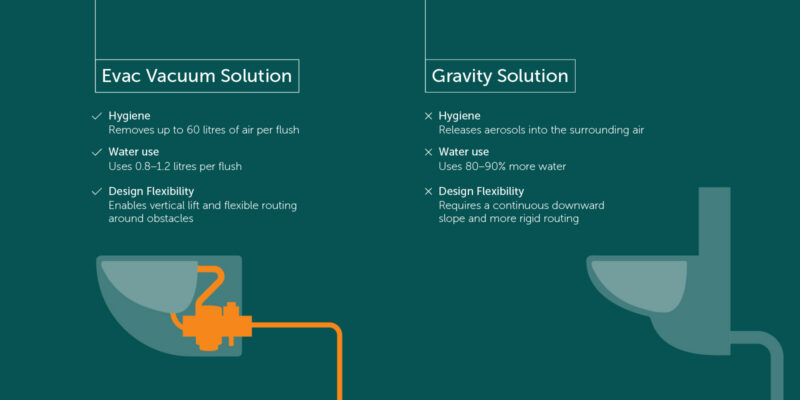
- Vacuum toilets use up to 90% less water than conventional toilets.
- Typical water consumption is just 0.8-1.2 liters (approximately 0.3 gallons) per flush for vacuum toilets compared to 4.8-6.0 liters per flush for modern gravity toilets, and up to 13 to 26 liters for older model gravity toilets.
- Vacuum toilets remove approximately 60 liters (2.1 cubic feet) of air per flush, improving odor control and hygiene.
- In specific applications, for example, radioactive waste management in hospitals, water savings also means less water needs to be treated.
- Lower water consumption supports green building initiatives and sustainability goals.
Comparing a Vacuum Drainage System to a Gravity Drainage System
| Feature | Vacuum Drainage System | Gravity Drainage System |
|---|---|---|
| Installation | Fewer and shallower trenches | Needs deep excavation and sloped pipelines |
| Water Usage | Utilizes air, decreasing water use | Requires significant amounts of water |
| Flexibility | Moves waste around obstacles and against gravity | Dependent upon natural slopes |
| Hygiene | Minimized contamination risks due to closed system | Increased exposure risks from open ventilation |
| Cost | Lower installation and maintenance costs for larger facilities, as well as long-term savings | More excavation and construction can lead to higher costs |
How Does a Vacuum Drainage System Work?
Unlike traditional gravity-based systems, vacuum systems use differential air pressure to create a powerful vacuum. Wastewater is carried efficiently through the piping network as part of an air-water mixture.
A vacuum drainage system has 3 primary elements:
- The vacuum interface
- Vacuum toilets
- The vacuum collection units
A vacuum pump generates vacuum in the piping. When a toilet is flushed, higher-pressure atmospheric air flows into the lower-pressure piping through the toilet or the interface. The air moves at high velocity, carrying the wastewater.
A typical toilet flush moves wastewater between 10 and 25 meters to the next transport pocket. There, a reserve is created to form a bolus of water. With the next flush, the wastewater moves another 10 to 25 meters until it reaches the collection unit. From the collection unit, the waste is lifted where needed or discharged into the sewer system.
End User Advantages with Vacuum Toilets
Under some circumstances, vacuum plumbing systems offer architects and engineers significant advantages. These systems also provide benefits for the end users, including:
- Faster, cleaner restrooms – Due to the negative pressure differential with vacuum-pressure systems, toilets clear quickly and consistently, with fewer clogs and backups, allowing restrooms to stay cleaner and fresher.
- Easier maintenance, fewer repairs – Vacuum systems are generally easier to maintain and have fewer failure points than traditional gravity plumbing. This results in less downtime and a more reliable experience.
- More hygienic and quieter – As has been mentioned earlier, due to the lower spray from the flush, vacuum-based plumbing systems are more hygienic and, in general, quieter than gravity-based systems.
Vacuum Drainage Maintenance, Regulations, and Codes
Maintenance typically focuses on the vacuum generation and collection units, the toilet and interface valves, and the airtightness of the piping network. Many building owners would use a planned service agreement with the system supplier so that inspections and replacement parts are scheduled proactively.
Vacuum drainage is a recognised wastewater removal method in building codes, including Section 715 of the International Plumbing Code (IPC) in the United States and EN 12109 in Europe. As local adoption varies, specifiers should confirm requirements with the relevant authority early in the design process.
Evac vacuum drainage systems offer a clean, green solution that is agile, convenient, and reliable, helping make your building future-ready.
To learn more about Evac’s line of total vacuum solutions, contact us today!
Contact Evac Built Environment team
Planning a new build, renovation or conversion? Tell us a little about your project, and our Built Environment team will show you how vacuum plumbing can help you meet your design, space and sustainability goals.