How to reduce water consumption in a busy transport hub
Recife Airport serves the capital of Pernambuco, one of the major urban centres in Northeast Brazil. For a busy transport hub handling large numbers of passengers and employees every day, sanitary facilities represent a significant source of water consumption.
Water efficiency was therefore one of the main drivers when Evac vacuum collection technology was first selected for the airport in 2003.
The motivation was both environmental and economic. Water represents a significant operating cost for large commercial facilities in Brazil, making reduced consumption particularly valuable for high-traffic locations such as airports.
By using vacuum technology instead of relying solely on conventional gravity drainage, considerably less flushing water is required. For a facility with hundreds of toilets in continuous use, reducing the amount of water used per flush can translate into significant savings over the lifetime of the system.
More than 20 years of Evac vacuum technology keeps delivering
The first phase of the project was completed in 2003 with the installation of an Evac Full 250 vacuum unit.
The system provided a nominal vacuum generation capacity of 680 m³ per hour and initially served 250 vacuum toilets.
Since then, Recife Airport and the demands placed on its infrastructure have developed considerably.
AENA has operated Recife Airport under a 30-year concession since 2020. As part of its continued investment in the airport, infrastructure has been expanded and modernised to support Recife Airport’s role as an increasingly important transport hub for Northeast Brazil.
The airport’s Evac vacuum system has developed alongside this expansion.
Modernizing the existing vacuum system
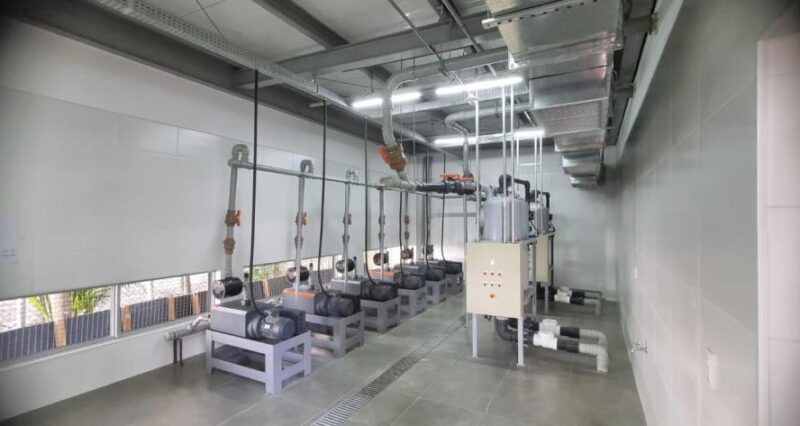
In 2023, the original Full 250 vacuum unit was replaced with two Evac Parati D60 vacuum units.
The new installation increased the airport’s nominal vacuum generation capacity to 1,020 m³ per hour, providing additional capacity while modernising a sanitation concept that had already been operating at the airport for approximately 20 years.
The project was therefore more than a replacement of ageing equipment. It allowed Recife Airport to retain the benefits of its existing vacuum sanitation infrastructure while adapting the system to the airport’s growing requirements.
Between 2023 and 2025, Evac also supplied approximately 200 additional vacuum toilets as part of the airport’s continued development.
Increasing capacity as Recife Airport grows
A further expansion followed in 2025 with the supply of two additional Evac Parati D60 vacuum units.
Following the latest phase, the airport has a reported total nominal vacuum generation capacity of 1,870 m³ per hour.
Approximately 450 Evac vacuum toilets are now installed across Recife Airport.
The phased development of the system has allowed vacuum collection capacity to grow alongside the airport itself. Rather than treating sanitary wastewater infrastructure as a fixed installation, capacity has been increased as passenger facilities and airport requirements have expanded.
This scalability is particularly valuable for a major airport undergoing continued development. Additional terminal areas and sanitary facilities increase the demands placed on wastewater infrastructure, making the ability to expand the existing system an important consideration in long-term planning.
Supporting long-term water efficiency
More than two decades after the first Evac system was installed, Recife Airport continues to use the same underlying vacuum sanitation concept while upgrading equipment and increasing capacity as its requirements evolve.
Water saving remains at the heart of the application.
By reducing the amount of flushing water required in heavily used sanitary facilities, Evac vacuum technology can help airports reduce potable water consumption and the associated operating costs.
For Recife Airport, the continued expansion of its Evac installation also demonstrates the long-term adaptability of vacuum technology. What started with one vacuum unit and 250 toilets in 2003 has developed into an airport-wide installation of approximately 450 toilets supported by a new generation of Evac vacuum units.
With further development of Recife Airport planned, the existing system also provides a foundation for additional capacity in the future.