Skip to content

From concept to fleet-wide impact: the R&D journey behind Cathelco’s DragGone system 

Every successful marine technology has a story behind it, usually one that includes equal parts curiosity, persistence, and real-world learning.
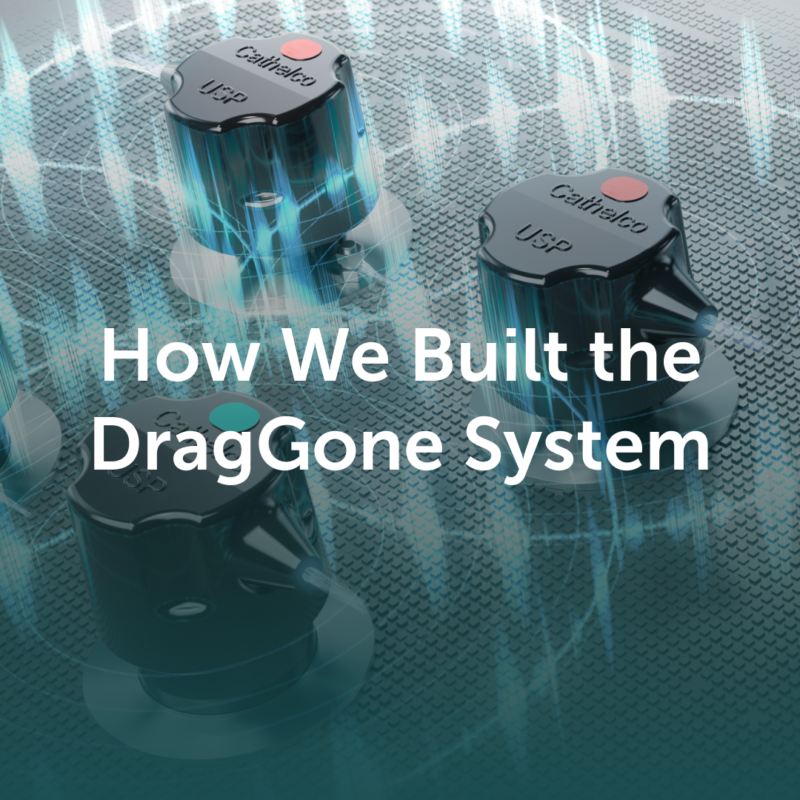
For Cathelco, the DragGone system began as an internal “CleanShip” initiative: a practical idea with a clear goal, reduce hull and propeller drag in a way that translates into lower fuel consumption, fewer emissions, and reduced risk of transferring invasive species. Like most new systems, the journey from first principles to repeat installations wasn’t a straight line. It was a development path with setbacks, breakthroughs, and a growing sense of confidence as testing, customer feedback, and independent verification began to align. 

Proving the principle: guided waves and heterodyning 

In the earliest stage, the team focused on answering a simple but critical question: can we reliably deliver energy where it needs to go to influence the fouling and drag mechanisms we’re targeting, without creating unintended side effects for the vessel or its surroundings? That meant structured testing to verify the underlying concept, including work around guided wave behaviour and heterodyning effects. These weren’t “marketing terms” in a slide deck; they were engineering realities that had to be measured, repeated, and understood. Early trials helped define what was feasible, what needed refinement, and what assumptions had to be challenged before anything could be taken from a bench environment to a ship. 
In-house prototypes: homemade, hands-on, and honest 

With the principle established, progress depended on getting practical. Much of the early product development happened in-house, where “prototype” really did mean homemade: built, modified, stripped down, and rebuilt again. Some iterations worked immediately; others failed in ways that were frustrating at the time but invaluable in hindsight. Each failure revealed something: a limitation in mounting approach, an unexpected interaction with materials, a performance constraint, or a reliability issue that could become critical offshore. That cycle of trial, learning, and redesign is what turned a promising concept into a system robust enough for marine conditions and maintainable by crews who need equipment to be dependable, not delicate. 
The first real-world milestone: installation in Canada 

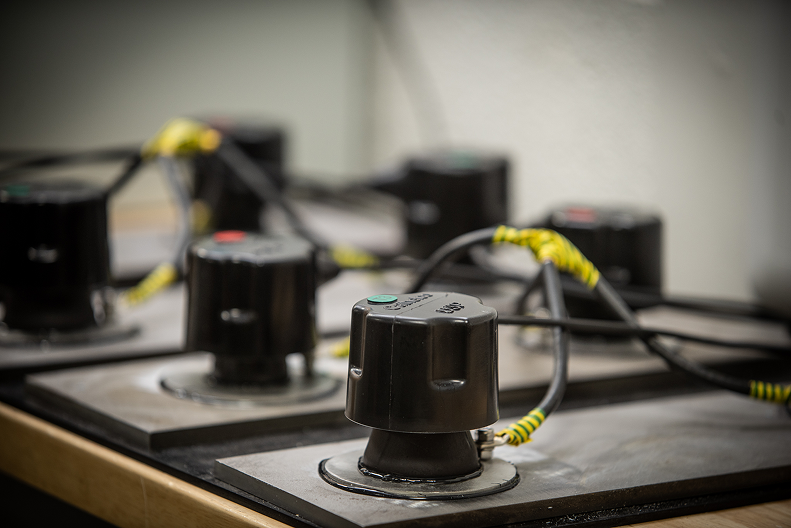
A defining moment in the DragGone story was the first installation, completed in Canada. That step matters because shipboard reality is the ultimate test environment: space is limited, schedules are fixed, access can be challenging, and the system must integrate safely with existing operations. Commissioning the first unit highlighted where installation guidance needed tightening, what onboard stakeholders cared about most, and how the technology behaved over time rather than just during short trials. The lessons from that first project fed directly back into design improvements and helped establish the installation and operational expectations that later customers would depend on. 

Independent verification and environmental considerations 

As the system matured, third-party testing became an essential part of proving performance and building confidence beyond internal results. Independent verification is especially valuable in the marine sector, where operators need to justify decisions with evidence and where performance claims must stand up to scrutiny. Alongside technical validation, the team also considered underwater noise and broader environmental effects. That meant asking not only “does it work?” But also “does it do so responsibly?” Designing with the environment in mind, particularly in relation to underwater acoustics, helped ensure that the technology aligns with the industry’s increasing focus on sustainability and operational stewardship. 

Designing for the shipyard: safety, practicality, and installability 
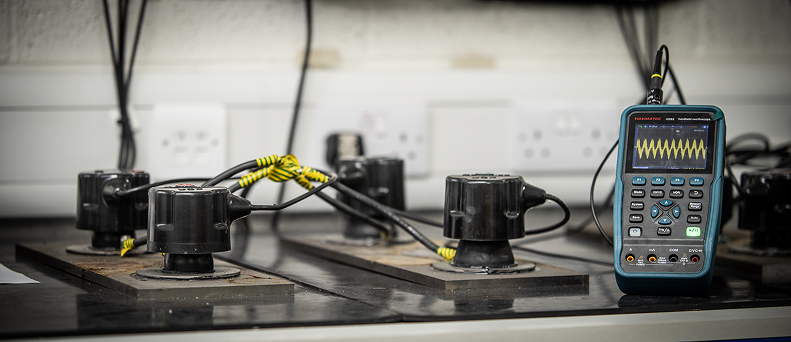
Another key strand of development was refining the product so it could be installed safely and consistently across different vessel types. A system can perform exceptionally in controlled conditions but still struggle in the market if it is difficult to fit, risky to handle, or complicated to maintain. Product enhancements therefore focused on practical engineering details: improving mounting concepts, simplifying installation steps, strengthening protection where needed, and ensuring the system works with shipyard realities. These refinements are often less visible than the “core technology,” but they are what make the difference between a one-off trial and a solution that can be deployed repeatedly with confidence. 

Customer collaboration: fitting the system to real operations 

From early on, customer engagement wasn’t treated as a final sales step, it was part of the engineering process. Working directly with operators helped clarify vessel-specific requirements and constraints, so Cathelco could propose a configuration that suited each customer rather than forcing a one-size-fits-all approach. The objective was always to avoid disruption to operational conditions while still achieving maximum results. When the system is properly matched to the vessel and its operating profile, the benefits stack up: reduced fuel consumption, lower emissions, and a meaningful contribution to limiting the transfer of invasive species associated with fouling and marine growth. 

From ups and downs to repeat business 

Looking back, the path from the initial CleanShip project to a finished product installed on multiple vessel types reflects the reality of innovation: progress comes with ups and downs. There were moments when prototype results forced a rethink, where installation learning demanded redesign, and where verification raised new questions to answer. But there were also breakthroughs. Those points where data, onboard experience, and operator feedback all confirmed that the technology was delivering meaningful value. Few things match the sense of achievement that comes from seeing strong results in service and hearing directly from customers that the system is doing what it was designed to do. 

What comes next: niche applications, propellers, and beyond marine 

The most exciting part of developing a technology like DragGone is that “launch” is rarely the end of the story. The team continues to look for ways to improve performance, simplify installation, and widen the range of vessel types and operating profiles the system can support. That forward momentum is driven by the same approach that shaped the early CleanShip work: measure carefully, learn quickly, and iterate with purpose. 

There is also growing interest in adapting the technology for niche areas and propellers, applications where geometry, access, and operating conditions can be very different from typical installations. And while shipping remains the core focus, the underlying principles may prove relevant in adjacent industries where surface condition and efficiency matter. For Cathelco, that’s the long-term value of rigorous R&D: it produces a solution that not only works today, but can keep evolving, helping customers cut fuel and emissions, protect performance, and operate more sustainably for years to come. 
Subscribe to our newsletter for more insightful topics. Our zero-spam-policy keeps your inbox unclogged.

70 years of Cathelco: our story so far

This year, we celebrate 70 years of Cathelco.

Founded in 1956 and headquartered in the UK, we have spent seven decades focused on protecting ships and the systems that keep them running.

Where it started

Our first Marine Growth Prevention System was installed in 1963 on a Royal Navy submarine. The principle behind it is electrolysis: copper and aluminium anodes prevent marine organisms from colonising seawater pipework while suppressing corrosion. The science has not changed. What has evolved is the technology around it, from panels to controls to digital capability.

Over the following decades, MGPS and ICCP became an industry standard. Our systems are now installed on more than 20,000 vessels worldwide, across commercial shipping, offshore, naval, and leisure marine sectors. We operate from offices in the UK, India, the Middle East, and Singapore, supported by a distribution and service network spanning more than 40 locations.

What has kept us here

Less than 1% of the systems we supply fail. That is a track record built on engineering rigour, consistent service, and a team that understands what vessel operators actually need.

People really collaborate to get the job done. Whatever the barrier, whatever the customer need, people will get it done. The seemingly impossible is possible.”

Customers come to us because they trust the product and the people behind it. Our systems are so widely recognised that, as one colleague recently put it, “you say the word Cathelco and they already know.”

Since 2018, we have been part of the Evac Group, a Finland-based cleantech company. That partnership has brought new resources and a wider strategic perspective, while the core of what we do has stayed the same.

Broadening the portfolio

Our most significant recent development is USP DragGone™, a patented ultrasonic biofouling prevention system designed for hull protection. Every vessel with an MGPS system is also a candidate for hull protection, and DragGone™ is the only system on the market that uses Guided Wave and Heterodyning technologies to deliver broader frequency coverage and larger protection areas per transducer than conventional ultrasonic systems.

DragGone™ has been independently validated at the DHI Maritime Technology Evaluation Facility and is now installed across a range of vessel types, from superyachts and passenger ferries to bulk carriers and offshore support vessels. It has been recognised with the Technology of the Year award at the Maritime Decarbonisation Awards and the Innovation category at the Ship Technology Excellence Awards.

Where we are going next

The regulatory landscape around biofouling is tightening. The IMO’s focus on biofouling management continues to sharpen, and vessel operators are increasingly looking for practical, proven solutions that fit within evolving compliance frameworks.

We are investing in both our product range and our approach to market to make sure we remain a useful, accessible partner for the people navigating these changes.

Subscribe to our newsletter for more insightful topics. Our zero-spam-policy keeps your inbox unclogged.

A comprehensive list of Invasive Aquatic Species (IAS) threatening marine ecosystems 

Did you know that Invasive Aquatic Species (IAS) are widely recognised as a major pressure on marine and coastal biodiversity. When non native organisms establish in a new environment, they can compete with local species, change habitats, and disrupt food webs. For ports, coastal authorities, and vessel operators, IAS also create operational and compliance risk.

In this guide, we explain what invasive aquatic species are and summarise practical steps to reduce the likelihood of transfer via ships.

What are Invasive Aquatic Species (IAS)? 

InInvasive aquatic species are organisms introduced outside their natural range into an aquatic environment. They can include plants, animals, algae, and microorganisms. Not all non native species become invasive, but some establish successfully, spread quickly, and cause ecological or economic harm.

Common pathways that support spread include:

Human activity
Recreational boating, fishing, aquaculture activities, and movement of marine equipment can unintentionally transport organisms into new environments.

Ballast water from ships
Ships take on ballast water in one region and discharge it in another. That process can move a wide range of organisms between ports. This pathway has historically been a major contributor to marine introductions, and regulatory requirements and improved ballast water management practices have reduced risk in many parts of the industry.

Ship hulls and niche areas
A ship’s hull is the largest submerged surface and can transport attached marine growth between ports and regions. Risk is often concentrated in niche areas such as sea chests, gratings and strainers, rudders, and thruster tunnels. These recessed and complex spaces are harder to access, inspect, and clean, which makes them more prone to biofouling accumulation. Biofouling transfer is increasingly addressed through guidance and regional requirements, and further regulatory development is expected in coming years.

In addition, in water cleaning without capture or containment can release removed biofouling and coating debris into the sea. Uncontained discharge is recognised as a potential pathway for IAS spread.

Climate change
As seawater temperatures change, conditions that previously limited certain species can shift. Warmer temperatures can increase the likelihood that some non native organisms survive and establish in new regions.

Why marine environments are vulnerable to invasion?

Many marine habitats are diverse and productive, but they can also be sensitive to disturbance. Introducing a single invasive species can create knock on effects across multiple trophic levels, particularly when the newcomer is a strong competitor, an effective predator, or alters the physical habitat.

Common and well known Invasive Aquatic Species affecting marine ecosystems

Below are examples frequently referenced in discussions on marine and coastal invasions and shipping related transfer pathways.

Zebra mussels

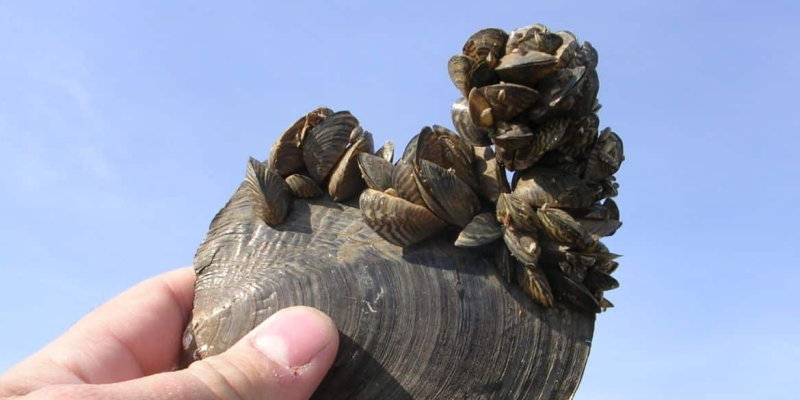
Zebra mussels are native to freshwater systems in parts of eastern Europe and western Asia. They were introduced to North America in the 1980s through ballast water discharge and spread rapidly by attaching to boats and equipment moving between waterways. Zebra mussels filter large volumes of water, which can increase water clarity. At the same time, filtration can reduce phytoplankton availability for native species. They also form dense colonies and often outcompete native mussels and other bivalves for space and resources.

European green crab

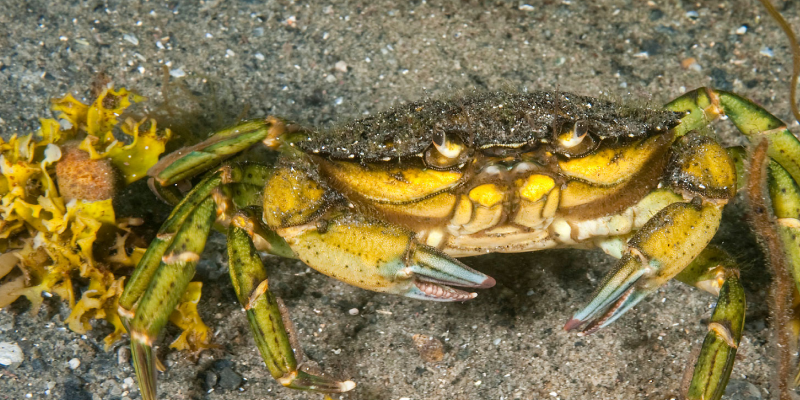
European green crabs originate from the northeast Atlantic and have been introduced to new coastlines through shipping related transport, including ballast water. Once established, they can spread along coasts through natural movement and additional transport on vessels and marine equipment. They prey on native shellfish such as clams and oysters and compete with native crabs for food and habitat. Their burrowing behaviour can disturb sediments and damage eelgrass beds, which are important habitats for many coastal species.

Lionfish

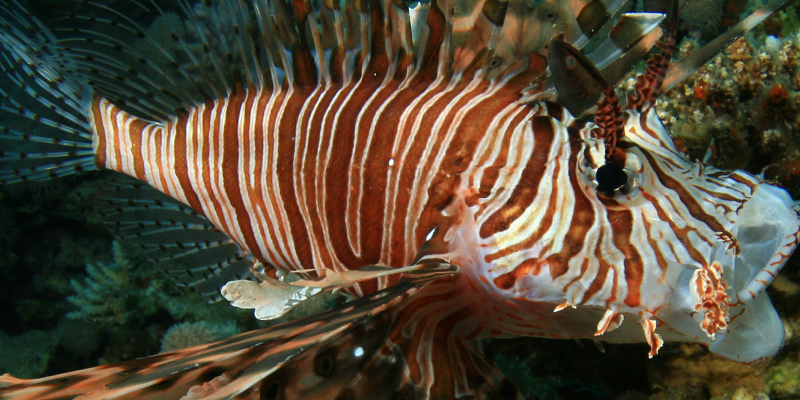
Lionfish are native to the Indo Pacific and were introduced to the western Atlantic largely through the release or escape of aquarium kept species. After introduction, they spread rapidly as larvae disperse with ocean currents. Lionfish are effective predators that feed on a wide range of reef fish, which can reduce native fish populations and alter reef community composition.

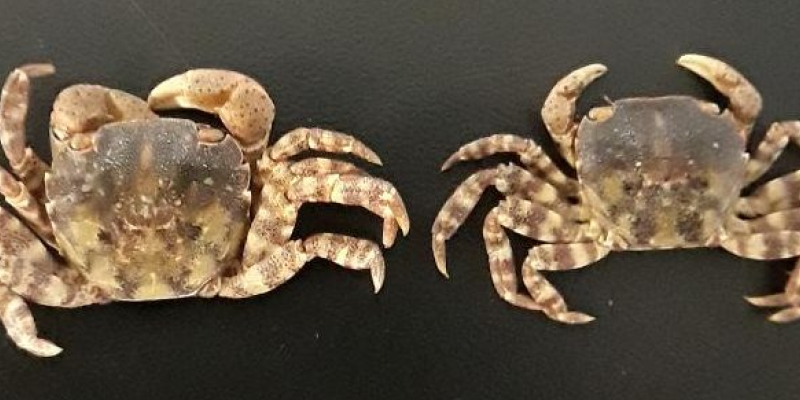
Asian shore crab

Asian shore crabs were first recorded on the US east coast in the 1980s. Their introduction is commonly linked to shipping related pathways such as ballast water and stowaway transport on vessels or cargo. They can spread further through coastal movement and repeated transport between ports. Asian shore crabs compete with native crabs for food and shelter and can reach high densities in suitable habitats. They also prey on native molluscs, adding pressure to local shoreline ecosystems.

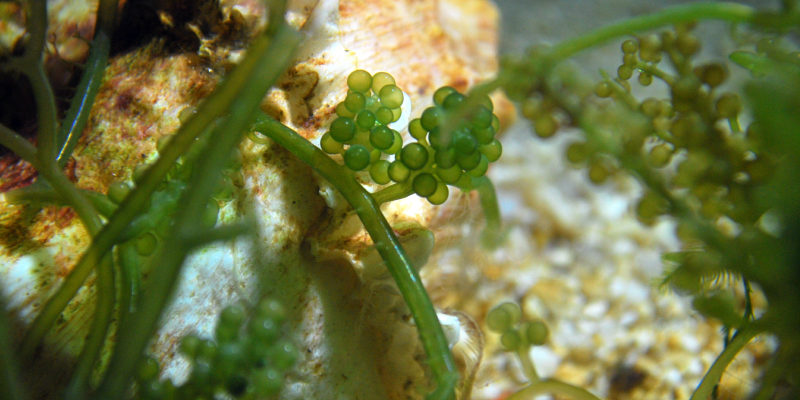
Caulerpa seaweed

Caulerpa species have spread outside their native range through the release or escape of aquarium kept organisms and through fragment transfer on anchors, fishing gear, diving equipment, and marine infrastructure. Because some Caulerpa can regrow from small fragments, even minor breakage can contribute to new outbreaks. Caulerpa can form dense mats that crowd out native seagrass and algae, reducing habitat quality for species that depend on those environments. Over time, this can change the structure of the seabed habitat and the communities that live there.

The impact of Invasive Aquatic Species 

IAS introductions are not only a conservation issue. They can affect coastal infrastructure, fisheries, tourism, and vessel and port operations. Impacts vary by species and location, but the patterns below are common.

Competition with native species 

Many invasive species compete directly with native organisms for food, space, and habitat. When an invasive species has fewer predators, higher reproduction rates, or broader environmental tolerance, it can gain a strong advantage.

European green crab is a widely cited example because it preys on shellfish and competes with native crabs. In areas where populations establish, local shellfish beds can be affected, with consequences for ecosystems and fisheries.

Research from the Journal of Fish Biology shows that competition can also destabilize local communities. As habitats degrade and resources become more limited, pressure increases across the food web. In some cases, less competitive species are displaced from key habitats, reducing overall biodiversity.

Habitat degradation 

Some IAS alter the physical or chemical conditions of habitats, which can create long term changes in ecosystem structure.

Zebra mussels, for example, can alter aquatic systems by filtering phytoplankton, shifting nutrient pathways, and changing the conditions that support native fish and invertebrates. On reefs, invasive predators such as lionfish can reduce herbivorous fish populations that help control algal growth. That can indirectly contribute to reef degradation, especially where reefs are already stressed by global warming, pollution, and/or overfishing.

Economic impacts 

The economic cost of IAS can be significant, particularly where invasive organisms affect fisheries, tourism, and infrastructure.

European green crab can threaten shellfish industries because commercially important species are part of its diet. Fouling organisms can also create operational problems. Zebra mussels are a well known example due to their ability to colonize and clog pipes and water intake systems on ships, increasing maintenance and cleaning requirements. Overall, invasive aquatic species damage is estimated at $120 billion annually in the US alone.

In shipping, biofouling that carries IAS increases drag and can reduce hydrodynamic performance, contributing to higher fuel consumption and emissions. For vessel operators, that creates a combined cost and compliance challenge.

Cascading impacts through marine food chains 

IAS can disrupt established ecological relationships. Invasive predators may reduce prey populations directly and also compete with native predators for food. Over time, these changes can shift which species dominate an ecosystem and how energy moves through the food chain.

How to prevent the spread of Aquatic Invasive Species 

Reducing IAS transfer risk requires a practical, multi-layer approach that combines operational controls with prevention technologies. The most effective programmes focus on stopping organisms from establishing in the first place and reducing the likelihood of release during maintenance activities.

Key prevention strategies

Manage biofouling in niche areas
Niche areas are often higher risk because they provide shelter from flow and are more difficult to inspect and clean. Marine growth prevention systems (MGPS) can help reduce fouling build up in seawater intakes and internal seawater systems. By using niche area mounted anodes to control conditions that support settlement and growth, MGPS can reduce the likelihood that organisms establish and are transported between regions.

Reduce hull biofouling to limit transfer risk
Ultrasonic antifouling systems use high frequency sound to create micro vibrations in the structure, which can make it harder for fouling to establish on treated surfaces. This approach can support hull cleanliness between maintenance windows and reduce drag build up over time.

Cathelco’s DragGone is an example of an ultrasonic antifouling system designed to support hull performance and efficiency. By helping to limit fouling accumulation, ultrasonic systems can also reduce reliance on frequent reactive cleaning and support broader biofouling management planning.

Use responsible in water cleaning practices
If in water cleaning is used, capture and containment can reduce the risk of releasing living organisms and coating debris into the surrounding environment. This is increasingly important for invasive species control and for local environmental requirements.

Control measures that support long term management

Biofouling management plans (BMP)
Many jurisdictions require ships to maintain a documented plan that outlines inspection routines, maintenance schedules, and cleaning procedures.

Biofouling record books
Keeping clear records of inspections, cleaning events, and actions taken helps demonstrate due diligence and supports operational consistency across voyages.

Protect your vessels from invasive aquatic species

Unchecked invasive aquatic species can disrupt ecosystems, affect fisheries, and increase operational costs in shipping. Prevention is most effective when it is proactive and practical, combining good housekeeping with technologies that reduce the likelihood of fouling establishment in the first place.

Cathelco supports operators with marine growth prevention systems for seawater intakes and internal seawater systems, and ultrasonic antifouling systems for hull performance support. If you would like to discuss biofouling risk reduction for your vessel type and trading profile, speak with our team.

Consult experts today to learn how Cathelco’s advanced technologies can help you deal with aquatic invasive species. 

Subscribe to our newsletter for more insightful topics. Our zero-spam-policy keeps your inbox unclogged.

Evac and Carnival Corporation sign global service contract for preventive maintenance of Evac systems

Espoo, Finland, February 5th 2026, at 19:00PM EEST

Carnival Corporation & plc (NYSE/LSE: CCL; NYSE: CUK), the world’s largest cruise company, has signed a new global service contract with Evac Group for preventive annual maintenance and lifecycle services covering Evac systems installed across the company’s eight world-class cruise lines.

The agreement follows a proactive, fleet-level approach extending the lifetime of Evac systems and improving reliability, efficiency and cost predictability. By planning maintenance in advance, harmonizing ways of working across cruise lines and including onboard crew training during annual visits, the service agreement aims to reduce the risk of unplanned outages and support Carnival Corporation’s decarbonization efforts.

“This agreement marks an important step in our strategy to safeguard the performance of our environmental systems while driving efficient operations,” says Vera Lannek, VP, Sourcing & Machinery Lifecycle Management, Carnival Corporation & plc. “By partnering with Evac as the original equipment supplier, we can leverage technology for a more proactive fleet-level approach that supports our operational& decarbonization objectives efficiently and also helps ensure a smoother, more reliable onboard experience for our guests by reducing the chance of system-related disruptions.”

With this proactive approach, Evac demonstrates its commitment to advancing a future with nothing to waste by helping cruise operators improve the performance, efficiency and sustainability of their onboard environmental systems through advanced maintenance concepts and services.

“We are proud to strengthen our long-standing cooperation with Carnival Corporation through this global service contract,” says Kourtney Dever, Head of Cruise Service North America at Evac Group. “By combining proactive annual maintenance, predefined spare part kits, onboard crew training, and fleet-wide health checks, we can help Carnival Corporation enhance reliability, predictability, and efficiency across the fleet.”

About Carnival Corporation & plc
Carnival Corporation & plc is the largest global cruise company and among the largest leisure travel companies, with a portfolio of world-class cruise lines – AIDA Cruises, Carnival Cruise Line, Costa Cruises, Cunard, Holland America Line, P&O Cruises, Princess Cruises, and Seabourn.

About Evac Group
Evac Group is a global leader in integrated water, waste and wastewater management solutions, as well as corrosion protection and marine growth prevention systems, for the marine, offshore and land-based construction industries. Guided by our promise Nothing to waste, we help customers cut waste, save water and lower emissions, supporting the shift toward more circular and sustainable operations.
Founded in 1979 and headquartered in Espoo, Finland, the company operates through offices in 13 countries across four continents and a network of representatives in more than 80 countries worldwide. In 2024, Evac employed around 540 people.


EVAC GROUP
Corporate Communications

For further information, please contact:
Vincent van Heun
Global Marketing Manager, Evac Group
Tel. +358 40 13 14 227
Email: Vincent.van.heun@evac.com

Never settle for less – getting it right

Evac systems operate in environments where small deviations can have significant consequences. Excellence comes from getting every detail right across the entire system lifecycle.

Evac’s high standards take shape early in engineering and design. The goal is to develop systems that behave exactly as intended – under all conditions. The difference between acceptable and excellent is often small, but those margins shape how reliably the equipment performs over its lifetime. 

This expectation is reflected in quality decisions made long before equipment reaches a shipyard. Evac does not accept components that are “close enough.” Exact specifications matter, as anything less introduces uncertainty.


The same attention to detail continues as designs move from concept into verification. Engineers analyze how components behave under different scenarios, reviewing system responses and refining the logic that governs how equipment operates in the field. The work is meticulous but essential.

Alejandro Álvarez Camino Vice President for Products and Engineering

Automation is not easy – you must make sure every piece is moving exactly as it should. If you think your solution is okay, you are already behind. We stay until we know a system is behaving as intended.

High standards at every stage

The quest for perfection is also visible in Evac’s procurement activities, even as schedules shift and customers change their requirements. When something changes, Evac’s sourcing teams will quickly evaluate sourcing alternatives if needed.

We always strive to find a solution, so we can be on time and deliver the project as expected.

Tiina Porraskorpi, Procurement Manager

We work closely with project management, engineering and manufacturers to ensure specifications are understood. Even small deviations are caught early, before they affect later stages.

The same discipline applies in customer-facing workflows. System projects involve large volumes of documentation: delivery notes, sales orders, compliance records and more. Many major shipyards have strict formatting requirements, so even small inaccuracies can disrupt commissioning or delay invoicing.

We can’t send delivery documents twice. They must be right the first time, or the timeline gets disrupted and the whole chain slows down.

Elsa Haavanlammi, Customer Service Manager

Fixing root causes

Never settle for less also shapes how Evac responds to recurring technical issues. Warranty data often reveals patterns that point to deeper causes. Rather than repeatedly replacing parts, warranty and engineering teams work together to eliminate the underlying problem. These actions reduce the risk of the same failure reappearing.

If a problem keeps repeating, we don’t accept it. We fix the underlying issue – even if it’s more difficult. Just good enough is not good enough when ships depend on us.

For Evac, never settle for less means going that extra mile to ensure trouble-free operation for our customers. By fixing root causes and learning from every installation, our teams deliver systems that perform dependably in the most extreme of conditions.

Aaro Vaitomaa, Warranty Manager

Finding success in collaboration – when expertise comes together

Evac works in an industry where systems are complex and customer needs constantly evolve. In this environment, collaboration between people and functions is the mark of success.

Collaboration around all of Evac’s projects begins long before a component is designed or a purchase order is placed. 

The process starts in portfolio planning, where different teams come together to determine which product improvements and new concepts should move forward. These sessions are held in open forums attended by people from across the company. Vice President for Products and Engineering Alejandro Álvarez Camino emphasises the value of this approach:

Alejandro Álvarez Camino Vice President for Products and Engineering

Real collaboration happens when people feel free to point out problems – not just agree. Our best product management decisions come from being openly challenged by our teams in global operations, sales, sustainability, service, engineering and other functions. Control gates ensure everyone has a shared understanding before we move forward.

The complexity of Evac’s solutions is precisely why collaboration matters from the outset. For example, Evac’s wastewater systems combine valves, sensors, pumps and treatment stages that must work together in demanding marine conditions. Understanding how each part behaves requires shared insight across disciplines.

We validate every part of our systems to make sure the constituent parts are working together perfectly. These reviews are highly detailed and strengthen the common understanding behind every technical decision.

Gerardo Gómez Millán Product Line Manager for Evac Wet Waste and HydroTreat systems

Collaboration across the supply chain

Evac’s procurement function experiences collaboration from a different angle. Manufacturing partners may face delays, or customers may adjust their expectations late in the process. Daily communication across departments ensures that decisions protect both quality and schedules. Procurement Manager Tiina Porraskorpi captures the reality:

Procurement is by definition about collaboration – we’re constantly balancing inputs from engineering, sales and suppliers. When a disruption occurs, no team can solve it alone. We pool expertise to find the solution.

Tiina Porraskorpi, Procurement Manager

During project execution, collaboration becomes even more visible. A missing part or an installation constraint can quickly disrupt the entire schedule. Evac’s customer service representatives may be the first point of contact, but the solution often expands to include other teams. Progress happens when the entire chain moves together.

As a project moves forward, we’re in constant contact with procurement, engineering and logistics. Everyone plays a role in keeping things moving. You feel the difference immediately when communication is strong

Elsa Haavanlammi, Customer Service Manager

Global cooperation to solve challenges

Handling of warranty claims follows the same collaborative principles. Large or complex issues rarely stay within the warranty team alone. Logistics, service, engineering and product teams all become involved as soon as a case escalates – often working across time zones.

Aaro Vaitomaa, Warranty Manager

Everyone comes together when there is a challenge to overcome. Collaboration becomes automatic. Big warranty issues almost always turn into cross-functional projects – product, logistics, service… we’re all involved. You solve things faster when you know the people in other departments personally.

Finding success in collaboration also means longer-term product improvements. Insights from vessel visits, yard interactions, warranty data and service reports feed directly into how future components and systems are designed. 

These observations come from different countries and time zones, so open channels of communication are essential. When usability challenges emerge – particularly in advanced treatment systems – engineering and product teams review field data and adjust designs to make operation more intuitive for crews.

Committed to quality – building reliability into every step

The standards we set at each stage of a customer delivery define how our systems perform in the field. Evac is committed to quality from the first prototype to the final installation.

Quality at Evac begins in the design decisions behind every component we deliver. Close cooperation with our manufacturing partners ensures those decisions translate into products that perform reliably in real-world conditions. Discussions around materials, tolerances and assemblies identify potential risks before production begins.

Tiina Porraskorpi is a Procurement Manager who oversees many of the suppliers behind Evac’s core assemblies. Her work involves constant coordination with manufacturers across Europe and Asia, ensuring that specifications are understood and any deviations are detected early.

Tiina Porraskorpi, Procurement Manager

Our commitment to quality depends on having suppliers with the same high standards. If something changes in their process, we ask to be informed immediately so we can assess whether it will affect our customers. Quality often comes down to planning.

Evac’s procurement, project management and engineering teams work closely together to validate new processes and components. Documentation is verified and any irregularities trigger internal reviews before equipment moves further into the production chain. By being committed to quality, Evac keeps standards consistent even as supply chains evolve.

Understanding real-world behaviour

Quality is also shaped by how systems behave once they leave the factory. Across Evac’s marine and land-based projects, wastewater systems, vacuum solutions and other equipment face demanding environments – often operating around the clock.

For me, quality means crews can operate our systems easily even when conditions are not ideal.

Gerardo Gómez Millán Product Line Manager for Evac Wet Waste and HydroTreat systems

Handling wet waste is a complex process, so we validate every part of the system. Then we bring lessons from each installation back into the design, so the quality continues to improve. This is in line with our target of building systems that are more robust with every new release.

Interactions with operators who use Evac equipment reveal small but meaningful details – a valve’s rate of wear, the way a control panel is used under pressure, or how service instructions are interpreted. Evac teams conduct regular failure mode analyses, scrutinizing how each component should act under different scenarios.

These observations feed directly into our product roadmaps. Engineering teams use the information to refine materials, adapt layouts or simplify maintenance steps. The aim is to reduce complexity and strengthen reliability across the entire product lifecycle, explains Gómez Millán.

Turning insight into improvement

Data also plays an important role in maintaining quality. Evac’s teams analyze warranty cases to identify patterns that may point to deeper design or material issues. When a recurring failure is detected, the case is escalated to product engineering so any underlying causes can be addressed. In complex marine environments – where quality is determined by compliance, safety and reliability – the cost of mistakes grows exponentially the later an issue is discovered. Evac Vice President for Products and Engineering Alejandro Álvarez Camino captures this principle in simple terms:

If something costs one euro to be done in the office, it costs ten in the factory and one hundred on the ship. From reviewing component drawings to ensuring installation happens on time, quality is determined at every step of the process.

Alejandro Álvarez Camino Vice President for Products and Engineering

When warranty data, operator feedback and early engineering checks inform the same decisions, issues are resolved at source and system reliability strengthens across the entire lifecycle. This is the day-to-day reality behind being committed to quality.

In it for the customer – standing by our customers, every step of the way

Our people have a deep sense of responsibility for the customers who depend on Evac systems. Teamwork keeps operations running smoothly, with support provided swiftly when needed.

Whether in buildings or onboard ships, Evac systems are designed to deliver reliable performance from day one. Behind this equipment are teams who stay connected with customers and partners throughout the entire lifecycle – from sales and installation, through to everyday operation and service support.

Customers trust Evac to coordinate a wide network of suppliers and ensure on-time delivery. A single delay can disrupt a commissioning schedule or a vessel’s planned departure. Our teams adjust quickly when timelines shift, protecting the customer from any ripple effects.

Elsa Haavanlammi is a Customer Service Manager for Evac’s system projects. Her team sits at the centre of Evac’s largest delivery projects – coordinating documentation and tracking schedules. Much of the team’s work comes during the commissioning phase, when service engineers have limited time for their work.

Elsa Haavanlammi, Customer Service Manager

Together with the project manager, we act as the voice of the customer. Their equipment delivery timeline becomes our timeline. When they call – we move.

Providing rapid support

In it for the customer also means staying engaged once a system enters service. Issues can appear unexpectedly, so our teams are ready to answer the phone whenever it rings.

Warranty Manager Aaro Vaitomaa often becomes the first point of contact when a marine customer is facing a critical system issue. His work involves coordinating with engineering and service teams to ensure the right expertise is mobilized without delay.

Usually when I get involved, something is already wrong. I was once on vacation and out on a lake fishing when a call came in from a vessel. The whole wastewater system had gone down. I immediately contacted colleagues to get remote support started.

Aaro Vaitomaa, Warranty Manager

His team sent an engineer halfway across the world with a vital component, so work could begin immediately upon arrival aboard the ship. Stories like these reflect a culture in which rapid response and real-world problem-solving are core to being in it for the customer.

From insight to improvement

Evac’s product teams remain closely aligned with the regulatory landscape as well. Through active participation in the MED and MARPOL committees, for example, Evac tracks upcoming marine requirements and interprets how new rules will affect customers’ operations.

Our role is to stay ahead of regulatory changes, so we can guide customers with advice that is both credible and practical.

Deeper customer needs often emerge during visits to vessels and project sites. Direct feedback reveals how equipment behaves and what would make it easier to use or maintain. Daily communication across Evac’s product management, sales and service functions ensures these insights are quickly turned into practical improvements. Keeping product development aligned with market needs is another clear expression of what it means to be in it for the customer.

Alejandro Álvarez Camino, Vice President for Products and Engineering

What is a sacrificial anode and why ICCP systems are a better solution?

If you’ve spent time at sea, you’ve likely dealt with chipped paint, rust, and corrosion more than once. As you know, steel and seawater are a challenging combination. Over time, seawater promotes corrosion, and while protective coatings help, they can deteriorate or become damaged and cannot eliminate corrosion risk entirely, particularly on submerged areas such as the hull.

One common method used to protect the hull is sacrificial anodes. These are shaped metal blocks attached to the hull that are designed to corrode in preference to the hull steel, reducing the rate of hull corrosion. 

The limitation is that sacrificial anodes are consumable and must be replaced as they wear away. In addition, once installed, their performance is largely determined by the anode material, the number and size of anodes, and the water conditions in which the vessel operates. They cannot be adjusted day to day. 

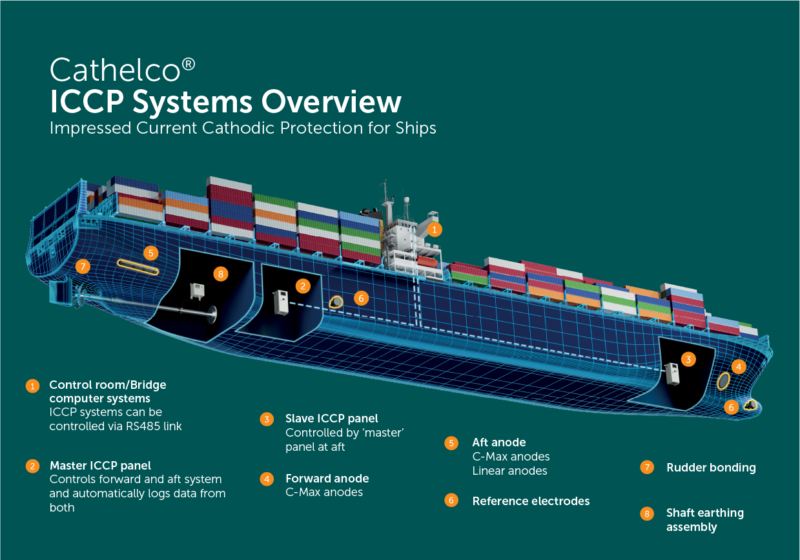
For this reason, most operators choose impressed current cathodic protection (ICCP) instead, or together with sacrificial anodes. ICCP uses powered anodes and reference electrodes to monitor the electrical potential at the hull/seawater interface and automatically adjust electrical output to maintain the appropriate level of hull protection as conditions change. 

Let’s explore what a sacrificial anode is, how it works, and why ICCP systems can be a better alternative. 

What is a sacrificial anode? 

Sacrificial anodes are devices designed to prevent the corrosion of metal surfaces, especially those exposed to electrolytes like seawater. The term itself is self-explanatory. These anodes create a galvanic anode cell, where the anode “sacrifices” itself to protect the cathode from galvanic corrosion. 

Sacrificial anodes consist of more reactive metals, which means they corrode preferentially, thereby sparing the less reactive materials they attach to. This way, they maintain the functionality of marine equipment and ensure a longer (and corrosion-free) lifespan for more important metals of ships and underwater structures.  

Besides ships and underwater structures, sacrificial anodes also work wonders in preventing corrosion in water heaters, pipelines, and tanks. 

In water heaters, the sacrificial anode is the metal rod that prevents the tank from corroding and eventually corrodes itself. The same is the case with both above-ground and underground tanks.  

How do sacrificial anodes work? 

Sacrificial anodes work through a galvanic (electrochemical) redox process: oxidation happens at the anode, while reduction reactions occur on the protected metal surface. 

When a sacrificial anode is electrically connected to a metal structure (like a steel hull) in seawater, the two metals and the seawater form a galvanic cell. The anode becomes the active metal and the hull becomes the cathode. Electrons released as the anode corrodes flow to the hull, keeping the hull surface cathodic and suppressing its corrosion. 

Simply put, the sacrificial anode corrodes instead of the hull. 

So how does a sacrificial anode prevent corrosion? It comes down to the natural electrochemical difference between the two metals. Sacrificial anodes are made from metals with a more negative electrochemical potential than the metal they’re protecting, so they preferentially oxidize and “take the hit” first.  

What are anodes made of? 

Sacrificial anodes are typically made from zinc, aluminium, or magnesium alloys. These alloys are more anodic (more active) than steel, so they corrode preferentially and protect the structure. 

Between the two main seawater options, aluminium anodes are widely used and can be cost-effective because they typically have a lower consumption rate than zinc for an equivalent protection requirement. Zinc anodes are also widely used in marine service and remain a common, proven choice for seawater protection. 

What are the disadvantages of sacrificial anodes? 

While sacrificial anodes work great, they do have their own set of limitations. These limitations can affect their overall performance and lifespan, making them unsuitable for certain applications. 

Short lifespan 

One of the main drawbacks of sacrificial anodes is their short and often unpredictable lifespan. Depending on the material and environmental conditions (like seawater temperature), they may need replacement in as little as six months. 

High chloride levels in seawater can also reduce the effectiveness and lifespan of sacrificial anodes. That rapid degradation means they need to be replaced frequently, which can be time-consuming and costly. 

Limited current output 

Sacrificial anodes also have limited current output. The amount of current an anode can produce is directly proportional to its weight. On larger ships, that can be a big issue as the demand for current capacity may exceed what the anode can realistically supply without adding excess weight. 

That means sacrificial anodes aren’t always suitable for large metal structures or those that require high current output. 

Hard to replace 

Replacing sacrificial anodes can be difficult, especially in hard-to-reach locations. 

For example, while the vessel is underway you will not be able to easily access the anodes for replacement. Even if you can, the process can be time-consuming and involves divers performing surface preparation and underwater welding. That adds to the maintenance burden and increases operational costs due to the need for additional labor. 

The benefits of ICCP systems over sacrificial anodes 

Unlike sacrificial anodes, ICCP systems have better control and performance, and more precise current control. This means optimal corrosion protection even with changing seawater conditions like temperature and salinity. 

Here are more benefits of ICCP systems: 

Longer life 

ICCP systems use inert anodes powered by an external current source, so they don’t corrode like sacrificial anodes. 

While sacrificial systems typically need replacement every 1 to 3 years, ICCP systems can operate for much longer, up to 15 years. This reduces maintenance, drydock time, and long-term costs. 

That alone makes ICCP systems a better option for long-term corrosion protection. 

Adaptability to complex structures 

ICCP systems require fewer anodes and provide precise current control, unlike sacrificial anodes, which rely on mass to generate protective current. This makes ICCP ideal for large or complex hulls. 

The system adjusts automatically to changing seawater conditions, delivers even protection, and can be maintained without drydocking, saving both time and resources. 

Sacrificial anodes usually struggle to provide even protection due to “shading” effects. Meanwhile, impressed current cathodic protection systems can be custom designed to meet the specific needs of complex structures. This enables them to prevent corrosion more effectively than traditional methods. 
 
In short, ICCP systems are highly adaptable to complex structures, making them ideal for offshore platforms and large vessels with complicated hull forms. 

Lower lifecycle cost 

Although ICCP systems typically cost more upfront, that’s because you’re buying an active, monitored protection system, not just metal anodes. A typical ICCP package includes a control panel (power/control unit) plus hull-mounted anodes and reference electrodes that continuously measure hull potential and automatically raise or lower anode output to maintain the optimum level of protection. 

Over the long term, that added equipment delivers value through more precisely controlled protection and long service life (for example, Cathelco’s flush-mounted ICCP anodes have a design life of around 15 years, far longer than sacrificial anodes). 

If you want to keep your ship corrosion-free and within budget, ICCP systems are a good investment. You can reduce operational expenditure on replacements and maintenance. 

Upgrade to ICCP with Cathelco 

ICCP technology is designed to reduce maintenance costs by protecting ship hulls and offshore structures from corrosion. Using hull-mounted anodes and reference electrodes, the system monitors hull potential and automatically adjusts current output to maintain the right level of protection as conditions change.

If you’re evaluating ICCP for your fleet or newbuilds, you can explore the options and specifications in our materials: view the product catalog online, or download the Cathelco ICCP brochure for a clear overview of system configurations and components.

Download the ICCP product brochure

Subscribe to our newsletter for more insightful topics. Our zero-spam-policy keeps your inbox unclogged.

Cathelco enables wider hull-area protection with ultrasonic antifouling by waterproofing transducers for wet spaces
The cofferdam add-on waterproofs transducer installations so ultrasonic antifouling can be fitted in wet spaces, unlocking transducer placement behind previously unreachable hull sections and enabling broader hull coverage.

Why coverage gaps matter

There is a simple reality behind hull biofouling management: you do not need a fully fouled hull to lose performance. Localized fouling will still add drag, and drag translates quickly into higher fuel consumption and higher emissions.

The practical constraint on large vessels

For ultrasonic antifouling, achieving strong results starts with one practical requirement: being able to place transducers where they are needed to treat the entire waterside of the hull. On many large commercial vessels, that has not always been straightforward.

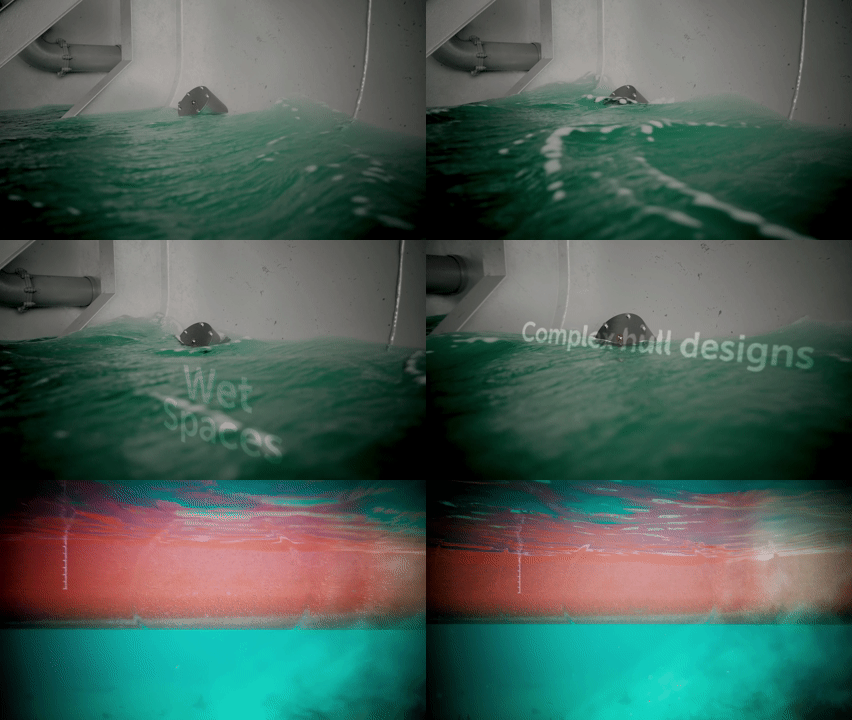
Large sections of the inner hull sit inside ballast tanks and other wet spaces, and traditional transducer installations require a dry environment. The result is that some ships have faced unavoidable coverage compromises, leaving parts of the waterside hull outside the treated area.

The solution: waterproof transducer installations in wet spaces

Cathelco has introduced a new cofferdam add-on to address that limitation and expand where its ultrasonic antifouling systems can be installed on large commercial vessels.

This enables installations in wet areas such as ballast tanks, bilges and other wet spaces. This in turn means transducer placement can be planned for the entire hull, rather than being dictated by where dry inner hull access happens to be available.

How the cofferdam works

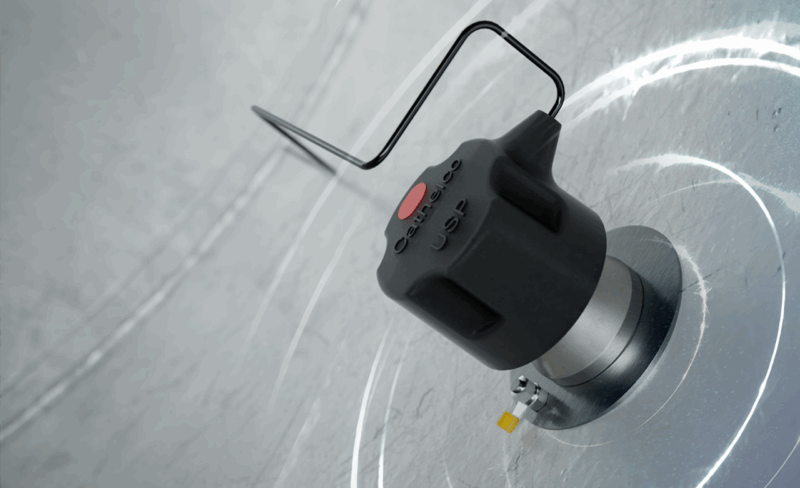
The cofferdam itself is a steel housing welded to the inner hull at the planned transducer location. The transducer is mounted inside the sealed chamber and secured with a lid to maintain watertight integrity. Cofferdams are specified only where needed, so projects can add waterproofing for the particular transducer locations that require wet-space installation.

Discuss your application

To request a quotation or discuss cofferdam applications for your vessel or project, speak with the Cathelco team. We can review your vessel arrangement, identify suitable transducer locations, and advise on where cofferdams may be needed to support broader hull coverage.

How it works: patented ultrasonic technology for commercial vessels

Patented technology

Cathelco’s USP DragGone™ system uses two key patented technologies—Heterodyning and Guided Wave—to create a highly effective antifouling solution. These technologies work together to disrupt biofouling organisms before they attach to the hull, even when your vessel is idling or operating at low speeds.

Heterodyning Technology

Multi-frequency protection for all waters

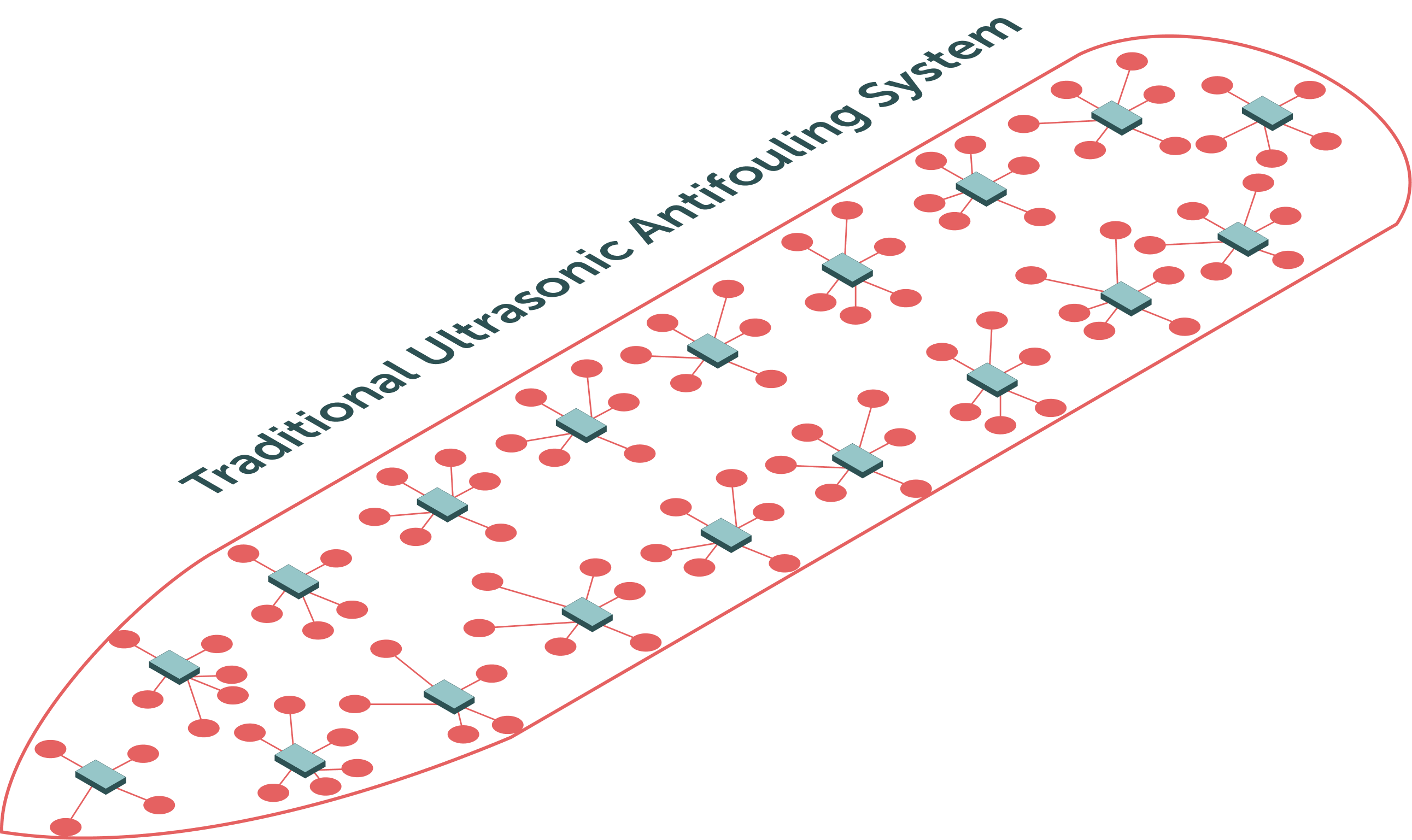
Generates multiple ultrasonic frequencies to target a wider range of fouling organisms compared to traditional ultrasonic antifouling systems.

Guided Wave Technology

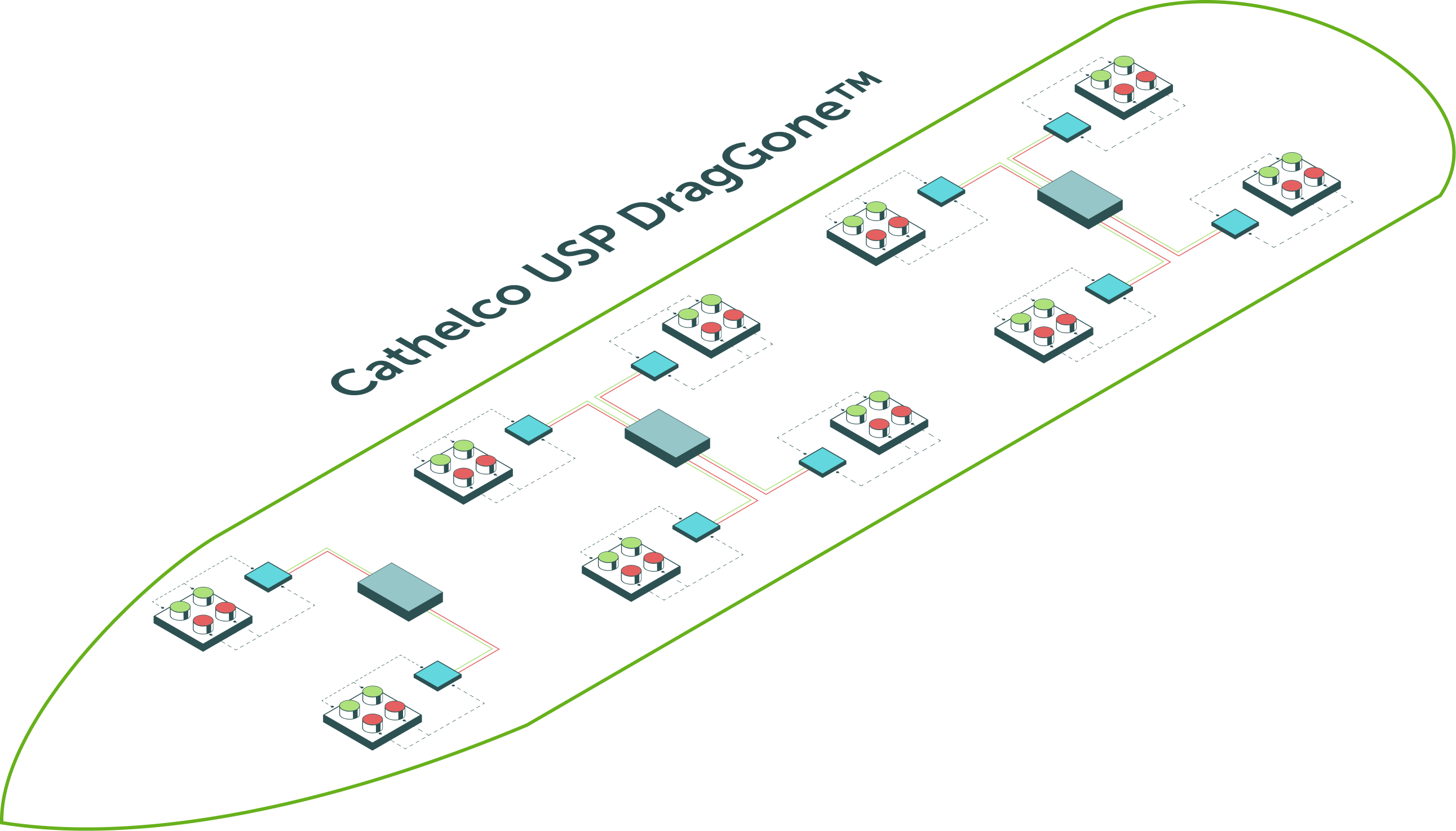
Complete hull coverage with fewer transducers

Channels energy through the hull structure, ensuring protection over a larger area with 60% fewer transducers, reducing the need for additional hardware and installation complexity. The DragGone™ system is 40x more efficient than traditional ultrasonic antifouling systems.

DRIVE EFFICIENCY, REDUCE EMISSIONS

Why commercial vessels choose USP DragGone™ for unmatched 24/7 hull protection

With the USP DragGone™ system, your hull is protected from biofouling 24/7, even during extended idle periods in port. This means less time spent on hull cleaning, fewer logistical disruptions, and lower maintenance costs. Keep your vessel operational longer and reduce costly downtime.

DragGone™ helps extend the time between hull cleanings, reducing the risk of coating damage during cleaning operations. By keeping your hull biofouling-free, you’ll reduce the frequency of reapplications and minimize overall maintenance costs.

Our ultrasonic antifouling system offers a non-toxic, non-biocidal solution to biofouling, ensuring your offshore vessel remains compliant with environmental regulations. This means less transfer of invasive species and reduced environmental impact, making it easier to meet global sustainability standards.

Trusted by ship engineers and crew, the DragGone™ system operates silently and efficiently, ensuring no disruptions to your crew or equipment. It’s the ideal solution for commercial vessels, delivering advanced biofouling protection without compromising vessel performance or crew comfort.

Subscribe to our newsletter for more insightful topics. Our zero-spam-policy keeps your inbox unclogged.

Contact us

Search