
Piping Infrastructure Planning: Optimizing Routing for Complex Building Projects
Civil engineers and architects work across a broad range of infrastructure projects, including transportation facilities such as airports, train stations, bridges, and highway structures; civic and public facilities such as convention centers; energy and industrial facilities such as data centers; and large-scale urban developments, including campus and waterfront master plans.
Vacuum drainage systems are particularly relevant to transportation hubs and civic and public facilities. Compared with conventional gravity drainage, vacuum systems can provide several advantages.
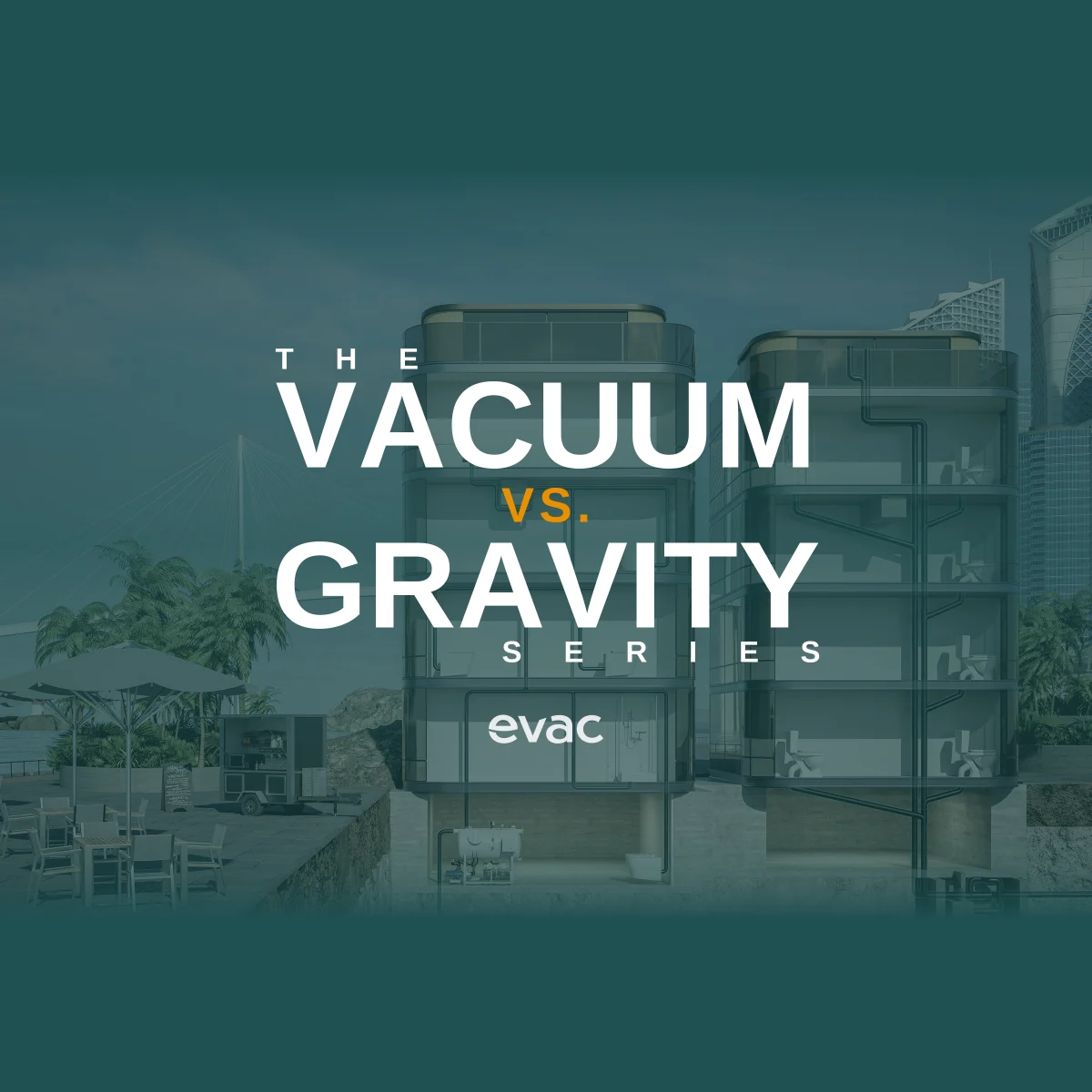
At a Glance
- Transport hubs, stadiums and other large public facilities face long pipe runs, tight service zones and difficult ground.
- Vacuum drainage needs no continuous slope, so pipes can run horizontally, vertically or overhead around obstacles.
- Vacuum toilets typically use 80–90% less water per flush than conventional gravity toilets.
- At Heathrow Terminal 5, vacuum drainage kept all pipework within British Airways’ area, with no penetrations into the floors below.
Gravity Drainage Versus Vacuum Drainage
Gravity drainage systems have served buildings and infrastructure for centuries, with roots extending back to Roman times. Vacuum drainage, while newer, is also a well-established technology. First used in Europe in 1882, vacuum systems were adopted in ships, trains, and aircraft before expanding into other applications. For today’s large-scale infrastructure projects, multi-use commercial developments, and historic renovations, vacuum drainage can offer significant design advantages, including greater flexibility, sustainability, and potential long-term savings.
- Gravity Drainage Systems – Conventional gravity drainage uses the force of gravity to move waste and wastewater through continuously sloped pipes toward a municipal sewer main or lower-elevation collection point.
- Vacuum Drainage Systems – Vacuum drainage uses negative pressure to transport waste and wastewater through a closed piping network. This allows piping to deviate from conventional gravity paths and navigate obstacles, including routing up slopes or vertically.
Vacuum drainage in this article means sanitary drainage from toilets and other fixtures, not siphonic roof drainage for rainwater, which is a different technology.
For designers, the principal limitation of gravity drainage is its dependence on continuous pipe slope. Below-grade routing can become particularly difficult when existing foundations, utilities, structural elements, bedrock, or changes in site elevation interfere with the required slope. By reducing reliance on gravity, vacuum drainage can provide greater routing flexibility and help accommodate the physical constraints of complex existing and new construction sites.
Saving Space and Design Flexibility
Traditional gravity-based plumbing requires continuous downward-sloping pipes, which can restrict the placement of restrooms and fixtures. Vacuum-based plumbing largely eliminates these constraints, providing greater flexibility in system design and routing.
- Pipes can run horizontally, vertically or overhead, with no continuous downward slope.
- Vacuum drainage is often well suited to challenging site conditions, including bedrock or other obstructions, insufficient or excessive slope, shifting ground, and high water tables.
- Smaller pipes need less space, which helps where service zones are tight.
- Many installations can avoid penetrating concrete slabs.
- Lift-pump stations and multiple underground collection points are often not needed.
- In large facilities with limited service space or complex horizontal routing, vacuum technology can reduce the amount of conventional drainage infrastructure required.
Significant water savings and sustainability advantages
Vacuum plumbing can help projects meet ambitious water- and resource-efficiency objectives, including those associated with LEED, BREEAM, and WELL* certifications. Its combination of low-flush water consumption and flexible system design can improve building efficiency while potentially reducing environmental impact.
- Vacuum toilets typically use 80–90% less water per flush than conventional gravity toilets.
- A typical vacuum toilet uses just 0.8–1.2 liters (about 0.2–0.3 gallons) per flush, compared with 4.8–6.0 liters (about 1.3–1.6 gallons) for modern gravity toilets and 13–26 liters (about 3.4–6.9 gallons) for older models.
- In specialized healthcare applications involving radioactive waste, lower water use can reduce the volume of contaminated wastewater requiring treatment.
- Lower water consumption supports green-building, sustainability, and resource-efficiency goals.
Improved hygiene and odor control
Hygiene and odor control are important in any plumbing system but become particularly critical in high-use facilities, healthcare, hospitality, and food-service environments. Vacuum drainage systems rapidly extract wastewater and air through a sealed, negative-pressure network.
- Air-assisted extraction: Each flush draws about 60 liters (2.1 cubic feet) of air into the system.
- Reduced toilet plume: Rapid air extraction can help limit the escape of aerosolized droplets from the toilet into the surrounding environment.
- Containment of sewer gases: The sealed, negative-pressure network helps contain sewer gases within the drainage system.
From the end user’s perspective, vacuum systems can also provide several benefits:
- Cleaner, faster-flushing restrooms. Negative pressure enables rapid, consistent waste removal, which can help reduce clogs, backups, residual waste, and lingering odors.
- Simplified maintenance. In many applications, vacuum piping is accessible above floors or ceilings, potentially reducing the need for invasive repairs and minimizing restroom downtime.
- A more comfortable environment. Vacuum toilets have a different acoustic profile from conventional gravity toilets, while rapid extraction can minimize residual waste and spray in the bowl.
Economic advantages
Over the life of a project, vacuum plumbing and drainage systems can provide economic benefits compared with conventional gravity systems, particularly where site, structural, or routing constraints make gravity drainage difficult.
- Less demolition: Above-floor routing can reduce or eliminate some demolition and reconstruction costs.
- Faster installation: Smaller piping, flexible routing, and reduced slab work can shorten installation time in suitable applications.
- More efficient use of space: Smaller pipes and flexible routing can free valuable floor and service space for other uses, potentially increasing leasable or revenue-generating area.
- Fewer MEP conflicts: Flexible routing and smaller pipe diameters can reduce clashes between plumbing and other mechanical, electrical, and structural systems, simplifying coordination and installation.
- Less invasive construction: Reduced trenching and slab penetration can minimize disruption, debris, restoration work, and associated labor costs.
- Scalability: Vacuum systems can be expanded or modified as building needs change, providing flexibility for phased construction or future additions.
High-occupancy facilities such as airports, stations and stadiums see sharp peaks in restroom demand. The following projects show how vacuum drainage has been used in such settings.
Case Study #1: Shanghai Stadium, China
Premise: Shanghai Stadium is a 72,000-seat venue in Shanghai, China.
Challenge: Serving very high peak restroom demand across a large existing structure with minimal disruption.
Solution: Over 1,000 Evac vacuum toilets were installed, with long horizontal pipe runs. An 80%+ water reduction compared with conventional systems has been observed.
Case Study #2: London Heathrow Airport Terminal 5
Premise: When building Terminal 5 at London Heathrow Airport, British Airways planned to create 100 private bathrooms for its business and first-class customers.
Challenge: Sustainability and conservation were key issues during the planning of the project. In addition to the significant water savings using Evac vacuum toilets, the building’s constraints meant no drainage pipes could enter the floors below.
Solution: Terminal 5 was constructed with 100 private bathrooms and more than 200 Evac vacuum toilets and interface units, with toilets using 1.2 liters per flush. The Evac vacuum plumbing systems also allowed maximum layout flexibility while still containing all of the pipework within the British Airways domain and with no floor penetration.
Case Study #3: St. Pancras Railway Station, London
Premise: St. Pancras International Station was redeveloped for the Eurostar operation. This required preservation of the historical building while offering modern, up-to-date facilities.
Challenge: As in many high-use facilities, sustainability and water conservation were a significant consideration. Also, due to the historic nature of the structure, preserving the fabric of the structure with minimal structural penetrations was required.
Solution: Evac vacuum drainage systems met both criteria. The 1.2 liters per flush Evac vacuum toilet reduced toilet flushing water by 80%. The flexibility of the vacuum-based plumbing systems meant the drainage system was not reliant on falls, so toilets could be located at either end of the building without the need for major excavation. The system consists of more than 150 Evac vacuum toilets and interface units.
When designing and developing large-scale infrastructure projects, vacuum-based drainage systems can provide a range of benefits, including design flexibility, lower water use, odor control and potential long-term savings.
To learn more about Evac’s line of total vacuum solutions or how our solutions can help with your infrastructure projects, contact us today!
Tags
Recommended reading
Footnotes
*LEED, BREEAM, and WELL are three primary building certification systems used globally to measure a building’s impact on the environment and human health. LEED and BREEAM certify how “green” a building is. WELL certifies how healthy a building is for occupants.
Subscribe to our newsletter for more insightful topics.
Contact Evac Built Environment team
Planning a new build, renovation or conversion? Tell us a little about your project, and our Built Environment team will show you how vacuum plumbing can help you meet your design, space and sustainability goals.