
5 Reasons to Consider Vacuum Plumbing for Commercial Building Projects
For hundreds of years, gravity-based drainage systems have been the traditional, standard approach to moving waste and wastewater. And in many cases, such as new-build, standard low-rise construction, budget-driven residential projects, and suburban residential projects with traditional layouts, gravity-based plumbing systems are still preferable.
However, for many use cases, especially in commercial projects and renovations, vacuum-based systems offer significant advantages. Here are 5 reasons to consider vacuum plumbing for commercial building projects.
At a Glance
- Vacuum drainage moves waste with negative pressure, so pipes can run horizontally, vertically or overhead without a continuous slope.
- Vacuum toilets typically use 80–90% less water per flush than conventional gravity toilets.
- Smaller pipes and flexible routing mean less demolition, trenching and slab drilling in renovations and historic buildings.
- Because the network runs under negative pressure, a damaged pipe draws air in instead of leaking sewage into the building.
Gravity Drainage vs. Vacuum Drainage
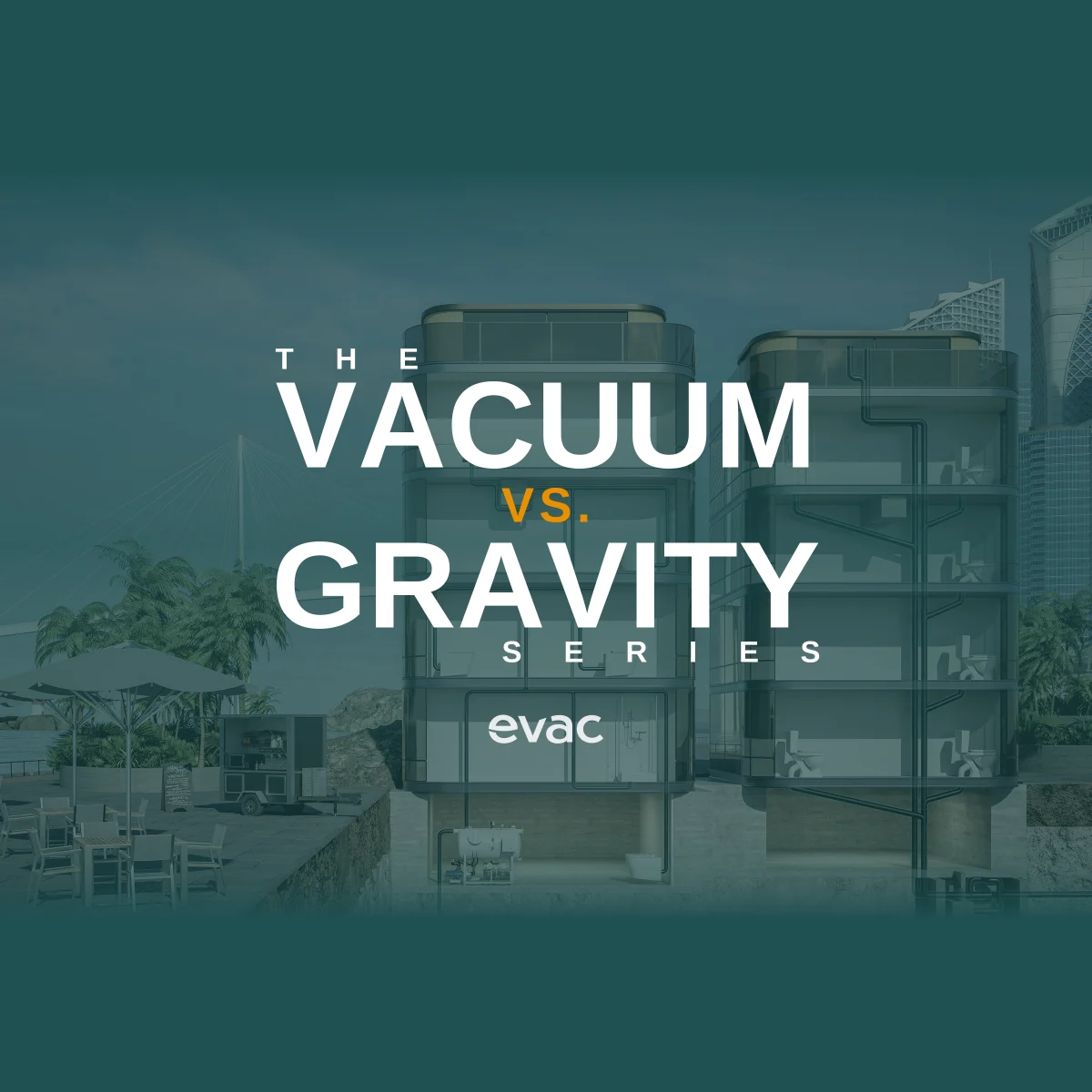
Gravity drainage systems rely on gravity to move waste and wastewater through sloped piping to a municipal sewer main or other collection point. Because of the need for wastewater to flow downhill, the design and installation are limited by the required pipe slope.
Vacuum drainage systems use negative pressure to transport waste and wastewater through a closed network of pipes. Unlike gravity-based systems, they can move waste around obstacles, up slopes and even vertically.
Vacuum drainage in this article means sanitary drainage from toilets and other fixtures, not siphonic roof drainage for rainwater, which is a different technology.
5 Reasons to Consider Vacuum Plumbing Systems
Although there are numerous reasons to select a vacuum plumbing system or a gravity plumbing system, let’s look at 5 categories in which vacuum plumbing systems have advantages.
Flexibility in routing and design
Traditional gravity-based plumbing systems require continuous downward-sloping pipes, which can limit where restrooms and fixtures can be located. Vacuum-based plumbing largely eliminates these architectural restraints.
- Wastewater can be transported horizontally, vertically, or overhead without maintaining a continuous downward slope.
- Vacuum drainage systems are often a strong option when there are terrain issues, such as bedrock or rock obstruction, insufficient or excessive slope, shifting ground, and high water table.
- Smaller-diameter piping requires less space and can simplify installation in areas with limited room.
- There is no need to penetrate concrete slabs in many installations.
- Lift stations and multiple underground collection points are often not needed.
Significant water savings and sustainability advantages
Projects pursuing ambitious water- and energy-efficiency goals – or those pursuing certifications such as LEED, BREEAM, or WELL* – may benefit from vacuum plumbing technology. By using substantially less water for flushing and enabling more flexible system layouts, vacuum technology can contribute to a building’s overall resource efficiency and potentially reduce a building’s environmental footprint.
- Vacuum toilets typically use 80–90% less water per flush than conventional gravity toilets.
- Typical vacuum-toilet consumption is just 0.8–1.2 liters (about 0.2–0.3 gallons) per flush, compared to 4.8–6.0 liters (about 1.3–1.6 gallons) for modern gravity toilets and 13–26 liters (about 3.4–6.9 gallons) for older-model gravity toilets.
- In specific applications, such as radioactive waste management in healthcare facilities, using less water can also reduce the volume of contaminated wastewater requiring treatment.
- Reduced water consumption supports green-building initiatives and sustainability goals.
Safer, less disruptive renovations
Renovation, adaptive reuse, and historic-preservation projects often involve structural limitations, restricted access, and limited opportunities to install new plumbing infrastructure. Vacuum systems can provide a flexible, lower-impact alternative to extensive modifications required by conventional gravity drainage.
- Faster installation: Smaller piping and flexible routing can simplify installation and potentially reduce project timelines.
- Less demolition: Vacuum piping can often be routed through existing spaces without extensive excavation or concrete removal.
- Lower labor and material requirements: Smaller pipes, reduced drilling, and simplified routing can help offset the higher initial cost of vacuum equipment.
- Better use of existing space: Flexible routing can help convert difficult or otherwise unusable areas into functional space.
- Fewer problems with existing inverts: Incorrect or inadequate pipe elevations can prevent conventional gravity drainage from functioning properly. Correcting these problems may require extensive demolition and redesign, whereas a vacuum system may provide an alternative solution.
- Easier navigation around structural elements: Post-tensioned slabs, steel columns, concrete piers, shear walls, and other structural components can be difficult and expensive to modify. Vacuum piping can often be routed around them.
Vacuum plumbing can be especially valuable in historic buildings, where preserving existing architectural and structural elements is a priority. Depending on the installation, vacuum systems can:
- Eliminate the need for floor trenching.
- Help protect historic flooring, tile, and structural foundations.
- Avoid or minimize disturbance of hazardous building materials, such as asbestos.
- Eliminate the need to maintain a gravity slope.
Improved hygiene and odor control
Hygiene and odor control are important considerations in any plumbing system, but become even more critical in healthcare, hospitality, and food service. Vacuum-based plumbing systems can offer strong odor control.
- Air-assisted extraction pulls about 60 liters (2.1 cubic feet) of air into the system with each flush.
- Helps limit toilet plume, the fine spray released on flushing.
- Keeps sewer gases inside a sealed, negative-pressure network.
From the end user’s perspective, vacuum systems can also provide:
- Cleaner, faster-flushing restrooms. The negative pressure differential allows toilets to clear quickly and consistently, helping reduce clogs, backups, and lingering odors.
- Simplified maintenance. Vacuum systems can be easier to access and maintain in many applications, potentially reducing repairs and restroom downtime.
- A more comfortable environment. Vacuum toilets can provide a different acoustic profile from conventional gravity toilets, while their rapid extraction helps minimize residual spray and waste in the bowl.
Reliable, leak-resistant operation
Undetected leaks in conventional gravity drainage systems can persist for extended periods, potentially causing water damage, mold growth, and structural problems before they are discovered.
Vacuum systems offer an inherent advantage because the drainage network operates under negative pressure.
- Negative pressure in a vacuum system holds pipes under a constant vacuum, pulling air into the system if a puncture occurs.
- Because the network operates under negative pressure, a damaged pipe tends to draw air in rather than let sewage out.
- Lower leak risk is especially valuable above sensitive areas such as data centers, museums and laboratories.
A conventional gravity-based plumbing system can be an excellent choice for a site that has no space restrictions, site problems, or budgetary concerns. But for many situations, especially in commercial construction and remodeling projects, vacuum-based waste systems offer many advantages.
To learn more about Evac’s line of total vacuum solutions, contact us today!
Tags
Recommended reading
Footnotes
*LEED, BREEAM, and WELL are three primary building certification systems used globally to measure a building’s impact on the environment and human health. LEED and BREEAM certify how “green” a building is. WELL certifies how healthy a building is for occupants.
Subscribe to our newsletter for more insightful topics.
Contact Evac Built Environment team
Planning a new build, renovation or conversion? Tell us a little about your project, and our Built Environment team will show you how vacuum plumbing can help you meet your design, space and sustainability goals.